
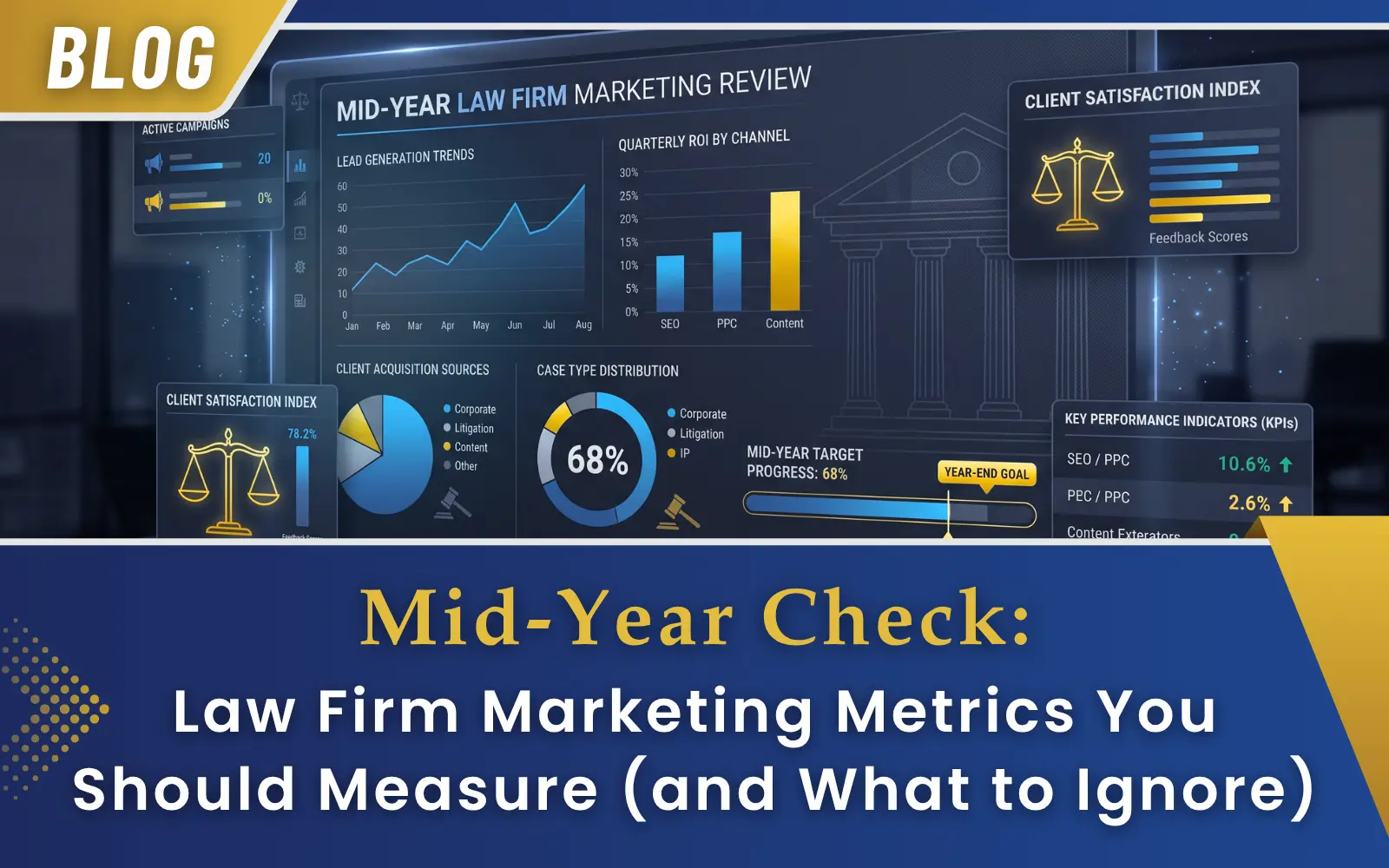
That disconnect often comes down to tracking the wrong law firm marketing metrics.
For aggressive-growth-minded lawyers and law firms, a mid-year review is not just about seeing whether traffic increased. It is about evaluating marketing effectiveness, identifying wasted spend, improving conversion rates, and understanding whether your marketing efforts are contributing to actual signed cases and revenue.
The most successful firms in the legal industry are shifting away from vanity metrics and toward performance indicators tied directly to client acquisition, profitability, and operational efficiency. That shift matters even more as search engines, AI Overviews, and digital channels continue to rapidly evolve.
This guide explains which law firm marketing metrics deserve your attention, identifies which metrics may produce misleading results, and helps you understand when your firm should pivot its strategy before more marketing spend is lost.
Read below to learn which law firm marketing metrics actually drive growth, which vanity metrics to ignore, and how lawyers can improve marketing ROI, conversion rates, and client acquisition during a mid-year marketing review. Contact Law Firm Marketing Pros to assess your marketing and build a plan to pursue your firm’s goals.
Key Takeaways
Before diving deeper into specific metrics, it is important to understand several core principles that separate successful law firm marketing from underperforming campaigns.
- Revenue-focused metrics matter more than vanity metrics.
- Website traffic alone does not indicate strong ROI.
- Law firm SEO KPIs should connect directly to consultations and signed cases.
- Conversion rates and client intake systems often reveal hidden growth barriers.
- Cost per signed case is usually more valuable than cost per click.
- Social media engagement may not correlate with new clients.
- Law firms should regularly review attribution and lead sources.
- Mid-year is the ideal time to pivot underperforming marketing campaigns.
- AI-literate legal marketers can help firms adapt to evolving search behavior and AI-driven search engines.
- Data driven decisions generally outperform instinct-based marketing choices.
Why Law Firm Marketing Metrics Matter More Than Ever
The legal marketplace has become more competitive across nearly every practice area. Whether a firm focuses on personal injury, estate planning, criminal defense, family law, or business litigation, firms now compete in increasingly crowded digital channels.
At the same time, prospective clients are researching lawyers differently than they did even two years ago. AI Overviews, voice search, local SEO, video content, and evolving search engine algorithms are reshaping how potential clients discover legal services.
Because of this, law firms cannot rely solely on surface-level performance indicators.
A firm may see rising keyword rankings, increased social media engagement, or higher website traffic while simultaneously experiencing declining conversion rates or stagnant revenue. Those are classic signs that marketing metrics are not being evaluated correctly.
The firms achieving sustainable law firm growth are usually focused on metrics tied to actual business outcomes:
- signed cases
- qualified consultations
- client acquisition cost
- law firm’s marketing ROI
- conversion rates
- lead quality
- revenue attribution
These indicators help identify areas where marketing efforts are succeeding and where operational or strategic changes are needed.

The Most Important Law Firm Marketing Metrics to Track
Not all marketing metrics deserve equal attention. Some directly impact firm performance and profitability, while others may mostly create noise.
Below are the metrics lawyers should prioritize during a mid-year review.
Cost Per Signed Case
For many lawyers, especially in personal injury cases operating under a contingency fee agreement, cost per signed case is one of the most important metrics available.
A personal injury attorney may spend heavily on marketing campaigns, but if the firm does not understand how much it costs to acquire a signed case, evaluating marketing ROI becomes difficult.
For example:
- A PPC campaign generating cheap leads may appear successful initially.
- However, if those leads rarely become clients, the campaign may actually create wasted spend.
- Another campaign with higher costs per lead could generate stronger cases with higher profit margins.
Cost per signed case provides clearer visibility into which marketing channels contribute meaningful business value for your firm.
This metric is especially critical for contingency fee firms because case value can vary depending on injuries, liability disputes, medical bills, insurance limits, and other fees associated with litigation.
Conversion Rates
Conversion rates help determine whether potential clients are taking meaningful actions on the law firm’s website.
Important conversions include:
- phone calls
- consultation requests
- live chat interactions
- case evaluations
- signed retainers
Strong website traffic without strong conversion rates often indicates problems with:
- client intake
- messaging
- website usability
- targeting
- trust signals
- page speed
- content quality
Many firms focus heavily on generating more traffic while overlooking whether visitors actually become clients.
Law firm’s SEO should not only drive traffic. It should drive qualified leads capable of becoming paying clients.
Client Acquisition Cost
Client acquisition cost measures how much the firm spends to obtain new clients.
This includes:
- ad spend
- SEO costs
- agency fees
- software costs
- automation tools
- content creation expenses
Tracking client acquisition cost across practice areas can help identify which campaigns produce strong ROI and which campaigns may require a strategic pivot.
For example, a personal injury lawyer may accept higher acquisition costs because contingency fee settlements can justify greater marketing spend. Other practice areas with lower case values may require lower acquisition costs to remain profitable.
Lead-to-Consultation Conversion Rate
The lead-to-consultation conversion rate metric often exposes missing opportunities inside law firms.
A campaign may generate excellent organic leads, but weak intake procedures can reduce overall marketing effectiveness.
Law Firms should measure:
- how quickly staff respond to inquiries
- how consultations are scheduled
- how calls are handled
- how many leads are lost during intake
Many law firms blame marketing when the real issue involves poor client intake systems.
Organic Traffic by Practice Area
Instead of evaluating general website traffic, firms should examine traffic tied to specific practice areas and commercial intent.
For example:
- A personal injury page generating consultation requests matters more than a blog generating irrelevant traffic.
- Traffic from potential clients searching for legal options carries greater value than informational visitors unlikely to retain counsel, although these informational visitors send reinforcing signals that your website is a valuable resource.
Law firm’s SEO should prioritize intent-driven visibility rather than raw traffic volume.
Marketing ROI
Marketing ROI remains one of the most important metrics for long-term strategic planning.
However, many firms calculate marketing ROI incorrectly.
Real law firm marketing ROI should evaluate:
- signed cases
- revenue generated
- marketing spend
- client acquisition cost
- operational costs
- intake efficiency & effectiveness
Firms that rely only on impressions, clicks, or social media metrics may misinterpret campaign performance.
Law Firm SEO KPIs That Actually Matter
Many lawyers obsess over keyword rankings while overlooking more meaningful law firm SEO KPIs.
Search visibility still matters, but rankings alone rarely tell the complete story.
Qualified Organic Leads
The best SEO campaigns generate qualified leads from search engines.
A law firm’s SEO strategy should prioritize:
- local SEO visibility
- practice-area relevance
- commercial intent
- geographic targeting
- authority-building content
Organic leads are generally more valuable when they align closely with the firm’s target audience.
Domain Authority and Topical Authority
Domain authority remains a useful comparative metric, although it should not be treated as a direct Google ranking factor.
Firms with strong domain authority often benefit from:
- stronger backlink profiles
- broader topical coverage
- improved credibility
- higher trust signals
However, topical authority increasingly matters more.
Search engines now evaluate whether firms demonstrate deep expertise across legal matters and related subtopics.
Bounce Rate
Bounce rate should be interpreted carefully.
A high bounce rate does not automatically indicate failure.
For example:
- A visitor who quickly finds a phone number and calls may technically “bounce.”
- Another visitor may stay several minutes without converting.
Bounce rate becomes more useful when analyzed alongside:
- conversion rates
- page engagement
- lead volume
- consultation requests
Local SEO Visibility
For firms targeting geographic markets, local SEO visibility can strongly influence client acquisition.
Google Business Profile optimization, reviews, local citations, and geographic relevance all contribute to stronger local SEO performance.
This is especially important for personal injury lawyers competing in highly competitive metropolitan markets.
Vanity Metrics Law Firms Should Stop Prioritizing
Some metrics create the illusion of success without contributing meaningful business outcomes.
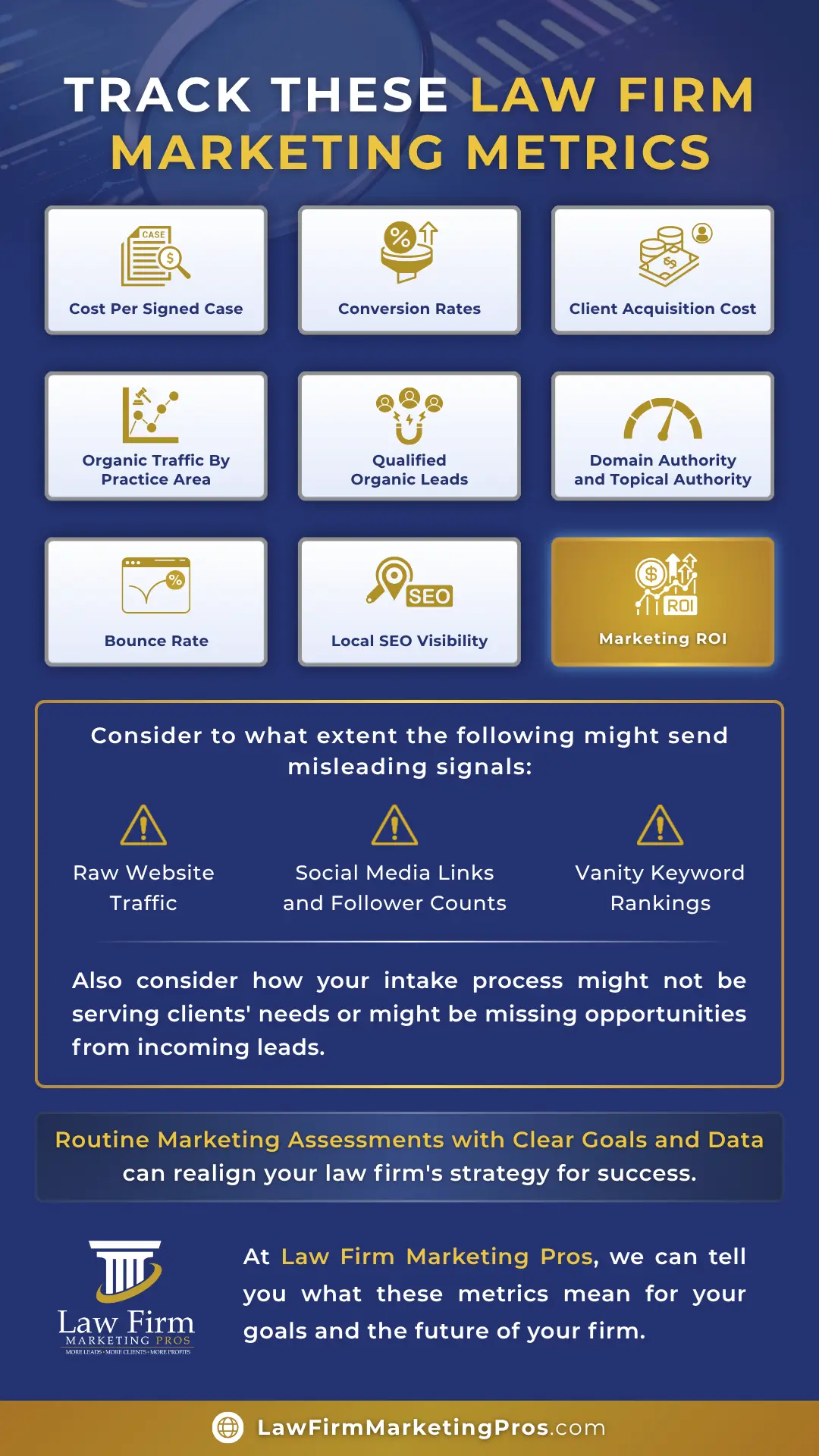
Raw Website Traffic
Increasing website traffic sounds impressive, but traffic alone does not pay operational costs.
Traffic is generally more valuable when it produces:
- consultations
- qualified leads
- signed clients
- revenue
Raw traffic metrics do not necessarily account for these outcomes, and may therefore lead to inflated perception of success.
Social Media Likes and Follower Counts
Social media can support branding and consistent messaging, but social media engagement alone rarely guarantees strong law firm’s marketing ROI.
Many firms spend excessive time chasing likes, shares, followers, or impressions without evaluating whether social media contributes actual consultations or new clients.
That does not mean social media lacks value. It simply means firms should evaluate how social media supports broader marketing goals.
Vanity Keyword Rankings
Ranking #1 for irrelevant terms rarely benefits the firm.
A personal injury attorney ranking for broad informational content may generate traffic that never converts into personal injury cases.
Law firm’s SEO should focus on terms tied to commercial intent and legal services rather than vanity rankings.
When Law Firms Should Pivot Their Marketing Strategy
A mid-year review should not merely collect data. It should help firms determine whether strategic changes are necessary.
Signs It May Be Time to Pivot
Several factors may indicate that current marketing campaigns require adjustment.
Rising Traffic But Declining Conversions
This often suggests:
- poor targeting
- weak website messaging
- intake problems
- low-quality traffic
Increasing Costs Without Revenue Growth
If marketing spend continues rising while signed cases remain flat, firms should reassess:
Poor Lead Quality
High lead volume does not always equal strong ROI.
If staff spend excessive time filtering unqualified inquiries, targeting may need refinement.
Weak Local SEO Performance
Firms relying heavily on referrals while neglecting local SEO may lose visibility to more digitally aggressive competitors.
Why Data Driven Decisions Matter
The most successful legal marketers rely on data driven decisions instead of assumptions.
This includes:
- attribution tracking
- conversion analysis
- intake reporting
- ROI evaluation
- channel comparison
Data helps identify areas where marketing dollars create measurable results and where wasted spend occurs.

The Growing Importance of AI and Search Evolution
Search engines are evolving rapidly due to AI-driven search experiences.
AI Overviews increasingly summarize information directly within search results, which changes how firms earn visibility.
Law firm’s SEO strategies increasingly need to emphasize:
- topical authority
- structured answers
- FAQ content
- entity relevance
- trustworthy authorship
- comprehensive educational content
Firms that fail to adapt may struggle to stay competitive over the coming year.
At the same time, aggressive-growth-minded firms should recognize the value of working with legal marketers who understand both traditional SEO and emerging AI search needs.
An AI-literate marketing team can help lawyers adapt content strategies, improve structured visibility, and respond proactively as search behavior changes.
The Role of Client Intake in Marketing ROI
Even strong marketing campaigns can fail if intake systems underperform.
Client intake directly influences:
- conversion rates
- marketing ROI
- client acquisition
- firm profitability
Common intake mistakes include:
- delayed responses
- missed calls
- inconsistent messaging
- lack of follow-up
- poor screening procedures
For contingency fee firms handling personal injury matters, intake quality can dramatically affect revenue outcomes.
A delayed callback may result in potential clients hiring another firm before your staff even responds.
Why Attribution Tracking Matters
Many firms struggle to understand which marketing channels actually generate clients.
Without proper attribution, firms may:
- overinvest in underperforming channels
- undervalue successful campaigns
- miscalculate marketing ROI
Firms should track:
- lead sources
- signed cases by source
- consultation conversion
- referral channels
- phone call attribution
Google Analytics, CRM systems, and call tracking software can help firms better understand how each channel contributes to client acquisition.
Building a Smarter Mid-Year Marketing Review
A productive mid-year review should focus on operational clarity rather than surface-level metrics.
Lawyers should regularly review:
- marketing ROI
- conversion rates
- client acquisition cost
- law firm SEO KPIs
- intake performance
- website traffic quality
- domain authority trends
- lead sources
- social media effectiveness
- email marketing performance
The goal is not simply generating activity. The goal is building sustainable growth with measurable outcomes.

Common Mistakes Law Firms Make During Marketing Reviews
Several common mistakes repeatedly undermine otherwise promising marketing strategies.
Overreacting to Short-Term Fluctuations
SEO performance naturally fluctuates.
Firms should avoid making drastic decisions based solely on temporary ranking changes.
Ignoring Intake Problems
Weak client intake can destroy otherwise effective marketing campaigns.
Chasing Every New Platform
Not every digital channel fits every firm.
Lawyers should prioritize platforms aligned with their target audience and practice areas.
Focusing Only on Costs
Lower costs do not always produce better results.
A campaign generating high-value cases may justify higher acquisition expenses.
FAQs About Law Firm Marketing Metrics
What are the most important law firm marketing metrics?
The most important law firm marketing metrics generally include cost per signed case, conversion rates, client acquisition cost, qualified leads, signed cases by source, and overall marketing ROI. These metrics connect directly to revenue and firm performance.
What metrics should law firms ignore?
Law firms should be cautious about overvaluing vanity metrics such as raw website traffic, social media likes, follower counts, and irrelevant keyword rankings that do not generate consultations or clients.
How often should law firms review marketing performance?
Most firms should regularly review marketing performance monthly while conducting deeper quarterly and mid-year evaluations to identify trends, missing opportunities, and areas requiring strategic changes.
Why is cost per signed case so important?
Cost per signed case helps firms understand the true value of their marketing efforts. This is especially important for contingency fee firms where case value, medical bills, and litigation costs can significantly affect profitability.
What are strong law firm SEO KPIs?
Strong law firm SEO KPIs include qualified organic leads, conversion rates, local SEO visibility, practice-area traffic, domain authority trends, and commercial-intent keyword performance.
Why are conversion rates important for lawyers?
Conversion rates reveal whether website visitors actually become consultations or clients. High traffic with low conversion rates may indicate problems with messaging, targeting, website usability, or client intake.
How does client intake affect marketing ROI?
Even successful marketing campaigns can fail if intake staff respond slowly or inconsistently. Client intake directly affects consultation scheduling, lead conversion, and overall marketing ROI.
Should law firms invest in social media marketing?
Social media can support branding, visibility, and audience engagement, but firms should evaluate whether and how social media contributes towards measurable business outcomes rather than focusing solely on engagement metrics.
How can law firms improve marketing ROI?
Law firms can improve marketing ROI by optimizing conversion rates, improving intake systems, refining targeting, strengthening local SEO, tracking attribution accurately, and focusing on high-performing marketing channels.
What role does AI play in modern law firm marketing?
AI is reshaping how search engines display information and how potential clients discover legal services. Firms that adapt content strategies for AI Overviews and evolving search behavior may gain competitive advantages over slower-moving competitors.
Trust the Experts at Law Firm Marketing Pros with Your Marketing Efforts
A mid-year review provides law firms with an opportunity to move beyond vanity metrics and evaluate what truly drives growth. For lawyers serious about staying competitive, the goal is not only visibility, but visibility that converts.
The firms achieving strong ROI are usually not the firms obsessing over likes, impressions, or superficial rankings. They are the firms tracking meaningful performance indicators tied to signed cases, client acquisition, intake efficiency, and profitability.
As digital marketing and search engines continue evolving, firms that prioritize measurable outcomes, operational clarity, and adaptable strategies will likely remain better positioned to attract potential clients and sustain long-term growth.
Join the elite law firms who trust Law Firm Marketing Pros and our proprietary Law Firm Client Generation System™. We’ll promote your law firm’s brand, create a hyper-optimized law firm website, and handle everything from web design to content marketing and law firm SEO incorporating AEO/GEO to the creation of a legal marketing funnel that drives qualified leads.
At Law Firm Marketing Pros, we partner with aggressive growth-minded attorneys seeking more cases by getting their digital marketing right. Result: Make more money, reclaim valuable time, and focus on what matters most.
Contact Partner and Co-Founder Josh Konigsberg, author of Law Firm Digital Marketing Made Easy: The Only Book You’ll Ever Need to Become a Best-Known Attorney, to schedule a free 15-minute client accelerator call at (561) 948-5001 or complete our online form.
Though brief, this call dives deep into your strategy. Josh will then prepare a complimentary digital marketing brief packed with 25-35 pages of value that drives qualified clients directly to your practice.
Copyright © 2026. Law Firm Marketing Pros. All rights reserved.
This blog is not intended to be legal advice for a lawyer or law practice. No special relationship or privilege exists between you and the Blog and/or its owners, Law Firm Marketing Pros, or its Affiliates (“LFMP”). LFMP IS NOT A LAW FIRM, and THE AUTHOR IS NOT AN ATTORNEY. You will be representing yourself and your law practice in any legal matter you undertake or any Client you represent as a result of your use of the information provided in the Blog, including any Services offered through the Blog and content available on the Site the Blog is published on and in all other matters relating to you and your businesses. This Blog may provide audio-video content, referenced articles, newsletters, and other content for informational purposes only. In the process of providing this information, the Blog is engaged in the publication of information regarding business and management issues that may be commonly encountered by law firms. This blog is not a substitute for the advice of an attorney. This Blog does not review any of your answers to questions for sufficiency, provide legal advice, or analyze applicable law and apply it to your specific requirements. Accordingly, if you need legal advice for a specific issue, you are advised to seek the advice of your local, state, and/or national Bar Association.
Law Firm Marketing Pros
250 S. Central Blvd, Suite 100-A
Jupiter, FL 33458
561-948-5001
https://lawfirmmarketingpros.com/