

“AI” — or so-called “Artificial intelligence” is evolving faster than almost any other technology affecting the legal profession, and this affects AI regulations for law firms. Every month seems to bring another announcement involving new AI tools, emerging legislation, revised ethical guidance, or another example of lawyers learning that artificial intelligence can create both opportunities and unexpected liability. As AI technology continues to mature, regulators are also refining how they approach oversight, moving away from broad attempts to regulate the technology itself and toward rules that focus on how AI systems affect people and organizations.
For attorneys and law firms, these developments are about far more than technology. They affect professional responsibility, client communication, legal research, marketing, document review, confidentiality, and ultimately the practice of law itself. Firms that embrace generative AI without appropriate governance may expose themselves to avoidable risks, while firms that avoid AI altogether may struggle to remain competitive as clients increasingly expect greater efficiency and innovation.
One recent example illustrates this shift particularly well. Colorado lawmakers recently replaced one of the nation’s most closely watched artificial intelligence laws with a more targeted framework that focuses on automated decision-making technologies (ADMTs) and measurable consumer impacts rather than attempting to regulate every form of artificial intelligence. Although the legislation applies within Colorado, its philosophy reflects a broader trend that legal professionals throughout the United States should follow. Similar discussions are taking place among state legislatures, federal regulators, bar associations, courts, and international policymakers, including those implementing the EU AI Act.
For lawyers, these developments reinforce an important reality. Compliance is becoming less about whether a firm uses AI and more about how AI use is managed, documented, supervised, and integrated into professional judgment. This evolution also has important implications for digital marketing, where generative AI has become an increasingly valuable tool for content creation, search engine optimization, client education, reputation management, and workflow efficiency. Used thoughtfully, AI can support sustainable growth. Used carelessly, it can create inaccuracies, ethical concerns, reputational harm, or regulatory scrutiny.
Law Firm Marketing Pros believes that successful AI adoption begins with education, transparency, and thoughtful implementation rather than chasing the latest trend. As regulations continue to evolve, working with AI-literate professionals who understand both legal marketing and the responsibilities unique to attorneys can help firms embrace innovation while remaining aligned with their professional obligations.
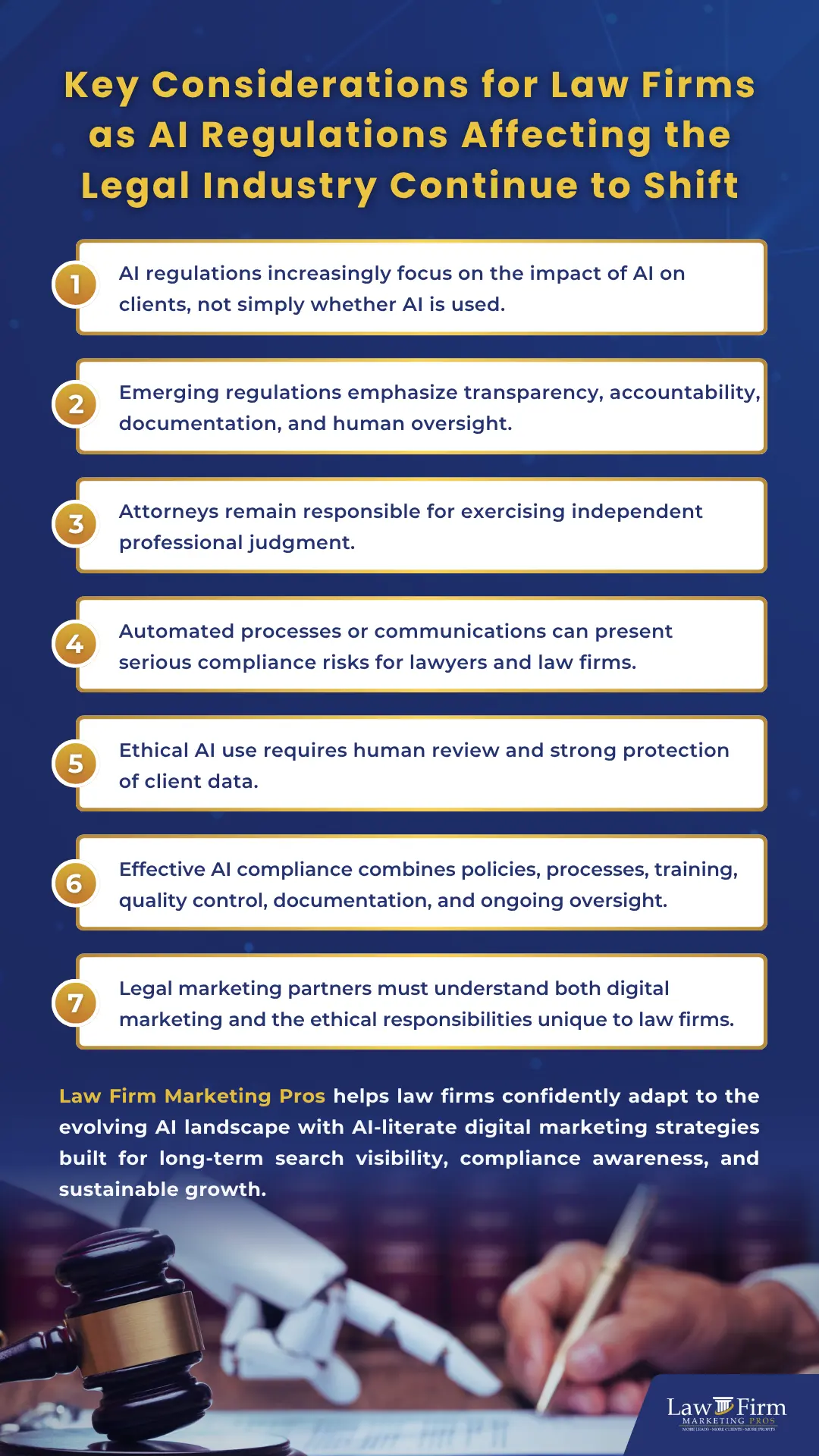
Key Takeaways
- AI regulations for law firms are increasingly focused on how artificial intelligence affects clients rather than simply whether AI technology is being used.
- States are shifting toward risk-based regulation that emphasizes transparency, accountability, documentation, and human oversight.
- Professional conduct rules continue to require lawyers to exercise independent judgment regardless of AI capabilities.
- Ethical use of generative AI requires attorneys to maintain human oversight over AI outputs and protect client data throughout every stage of legal workflows.
- AI compliance for law firms should include governance policies, training, quality assurance, documentation, and ongoing review rather than relying solely on software vendors.
- Marketing agencies serving attorneys should understand both digital marketing strategy and the ethical considerations unique to the legal profession.

Why AI Regulations Are Changing
Artificial intelligence has moved from experimental software to an everyday business tool in remarkably little time. Today, general AI tools and specialized legal AI platforms assist with legal research, document review, client communication, legal project management, drafting legal documents, preparing a legal brief, reviewing legal contracts, organizing legal workflows, and creating AI-generated content drafts for websites and educational resources.
As adoption accelerates, regulators have recognized that not every AI system presents the same level of risk. Rather than regulating all artificial intelligence applications equally, policymakers are increasingly distinguishing between low-risk productivity tools and AI systems that make or substantially influence consequential decisions affecting consumers.
This shift reflects a growing understanding that regulation should address outcomes rather than technology alone. An attorney using generative AI tools to organize research notes presents very different considerations than an AI system making decisions affecting employment, housing, healthcare, financial services, or other legal matters.
The legal industry occupies a unique position within this discussion because lawyers regularly handle sensitive client information, confidential legal work, intellectual property, privileged communications, and legal matters that directly affect individuals’ rights. Consequently, legal professionals are expected to exercise a higher degree of technological competence and professional judgment when adopting relevant technology.
Colorado’s New Direction Signals a Broader Shift in AI Governance
Colorado became one of the first states to adopt comprehensive legislation addressing artificial intelligence, drawing national attention from technology companies, business organizations, legal professionals, and policymakers. However, after significant industry feedback, lawmakers reconsidered aspects of the original framework and adopted a revised approach centered on automated decision-making technologies and demonstrable consumer impacts.
The revised legislation represents an important philosophical shift. Instead of broadly regulating AI technology itself, the law concentrates on situations where AI systems influence consequential decisions affecting individuals. This narrower approach seeks to encourage innovation while still promoting responsible AI development, transparency, and accountability.
Although most law firms are unlikely to deploy automated systems that directly determine employment or housing decisions, the underlying principles remain highly relevant. Legal professionals increasingly depend upon generative artificial intelligence, large language models, and AI tools to support legal tasks, improve lawyer productivity, assist legal assistants, streamline document review, and enhance operational efficiency. Each of these uses raises questions regarding human review, professional responsibility, client confidentiality, and appropriate supervision.
Colorado’s evolving framework demonstrates that AI regulation is becoming more nuanced. Rather than asking whether organizations should use AI at all, regulators are asking whether organizations understand how AI operates, whether they monitor AI outputs, whether biased data influences outcomes, whether documentation exists to support decision-making, and whether sufficient safeguards protect consumers.
For attorneys, this mirrors long-standing ethical expectations. Lawyers remain responsible for the quality of legal services provided to clients regardless of whether legal work involves traditional methods or AI-assisted processes.
Why These Developments Matter for Law Firms Across the United States
Some attorneys may assume that developments in Colorado have little bearing on firms practicing elsewhere. In reality, regulatory trends frequently influence broader conversations throughout the legal industry. Privacy laws, cybersecurity standards, and advertising regulations often begin in one jurisdiction before shaping policies in others or informing guidance from national organizations.
The American Bar Association has already acknowledged the growing role of generative AI through Formal Opinion 512, emphasizing that lawyers’ existing ethical obligations apply equally when using AI technology. The opinion reminds attorneys that competent representation, confidentiality, communication, supervision, and fee reasonableness remain governed by the ABA Model Rules regardless of whether legal work involves traditional methods or AI-assisted processes.
State bar associations are likewise examining how model rules address AI use, technological competence, unauthorized practice of law, client data protection, and professional integrity. Courts have also responded to high-profile incidents involving fabricated case law generated by AI systems, reinforcing that attorneys bear the ultimate responsibility for verifying citations, legal authorities, factual assertions, and legal analysis before submitting any filing.
These developments illustrate why AI compliance for law firms extends well beyond simply purchasing new software. Successful implementation requires thoughtful governance, attorney education, ongoing technical competence, and documented processes that maintain human oversight throughout legal practice.
Marketing departments and outside agencies should recognize these same principles. While generative AI used properly can dramatically improve efficiency in content development, search engine optimization, website management, and client education, every published resource should still undergo careful human review to confirm factual accuracy, reflect current law, protect client data, avoid unauthorized practice of law concerns, and align with applicable advertising rules.
The firms most likely to thrive during the coming year will not necessarily be those adopting the greatest number of AI innovations. Instead, they are likely to be those that combine responsible AI adoption with experienced professionals capable of balancing efficiency, accuracy, ethical use, and long-term strategic growth.
AI Compliance for Law Firms Begins with Governance, Not Technology
Many discussions about artificial intelligence focus on selecting the newest platform or comparing features among competing AI tools. While technology certainly matters, long-term success depends far more on governance than software. AI compliance for law firms is built on policies, oversight, training, documentation, and accountability that allow attorneys to use AI effectively while remaining consistent with their ethical obligations.
The legal profession has long adapted to new technologies, from email and cloud storage to electronic discovery and virtual court appearances. Generative AI represents another significant advancement, but its ability to produce convincing text, summarize information, and analyze large volumes of material creates risks that traditional software generally did not present. Unlike a word processor or document management system, generative AI may generate inaccurate statements, fabricate authorities, or produce incomplete analyses that appear credible at first glance.
For that reason, law firms should view AI systems as assistants rather than decision-makers. Every workflow involving AI use should identify where human review occurs, who is responsible for verifying accuracy, and how documentation is maintained. This approach aligns with the broader direction of emerging regulations that emphasize accountability rather than prohibiting innovation.
An effective AI governance program should include:
- Written policies governing approved AI tools and prohibited uses
- Procedures to protect client data and confidential information
- Training for attorneys, legal assistants, and marketing personnel regarding appropriate AI use
- Documentation describing acceptable legal tasks for AI assistance
- Human oversight before AI outputs are relied upon internally or shared externally
- Periodic reviews of AI systems and vendor practices, including data security measures and audit logs where available
- Clear expectations for maintaining professional judgment throughout AI-assisted workflows
These measures are likely to become increasingly valuable as additional states consider AI legislation and as courts continue evaluating the role of artificial intelligence in legal practice.

Unexpected Pitfalls That Many Lawyers May Not Anticipate
Most attorneys recognize obvious risks such as inaccurate AI-generated citations. However, many of the greatest challenges involve less obvious situations where AI capabilities intersect with evolving regulations, professional responsibility, and client expectations.
Understanding these risks allows firms to benefit from AI innovations while avoiding preventable problems.
AI Hallucinations Extend Beyond Fake Case Law
Highly publicized sanctions involving fabricated case law demonstrated that generative AI can create nonexistent judicial opinions. Although this example has become widely known, hallucinations can also affect statutes, regulations, factual summaries, witness timelines, contract provisions, and procedural requirements.
Even sophisticated AI systems occasionally generate information that sounds persuasive but lacks factual support. Legal professionals should independently verify every citation, quotation, legal brief, and legal research summary before incorporating it into client work.
The lawyer’s duty of competent representation requires more than accepting plausible AI outputs. It requires independent verification supported by professional judgment.
Confidential Information May Be Exposed in Unexpected Ways
Protecting client data extends beyond encrypting files or limiting system access. Attorneys should understand how each AI platform handles prompts, uploaded documents, training data, retention policies, and third-party access.
Before uploading legal documents or sensitive client information into generative AI tools, firms should determine:
- Whether information becomes part of future model training
- Whether uploaded content is retained
- Whether contractual safeguards exist
- Whether client consent may be appropriate
- Whether data leakage risks have been adequately evaluated
These questions affect both ethical use and practical risk management.
Regulations May Change Faster Than Internal Policies
Colorado’s revised approach demonstrates how rapidly AI governance can evolve. A policy adopted today may require revision next year as legislatures, courts, or regulatory agencies refine expectations.
Law firms should periodically review internal AI policies rather than treating compliance as a one-time project.
An annual governance review can evaluate:
- New legislation
- Updated formal opinion guidance
- Changes to model rules
- Emerging cybersecurity expectations
- Vendor practices
- AI capabilities
- Staff training needs
Continuous improvement often proves more effective than reacting after problems arise.
Unauthorized Practice of Law Risks Can Be Easy to Overlook
One of the more nuanced concerns surrounding generative AI involves unauthorized practice of law. While AI itself is not licensed to practice, firms must consider how clients and prospective clients interact with AI-generated information.
Examples include:
- Chatbots providing individualized legal advice
- Automated intake systems suggesting legal conclusions
- AI-generated content that appears to replace attorney analysis
- Marketing materials implying guaranteed legal conclusions
These situations may potentially create unauthorized practice concerns depending upon how the technology functions and how consumers perceive its recommendations.
Human oversight remains an important safeguard. AI should support attorneys rather than replace professional analysis.
Marketing Content Can Become Outdated Overnight
Many firms now use generative AI to accelerate website development, blog writing, FAQs, newsletters, and client education.
While these efficiencies are valuable, AI-generated content discussing statutes, regulations, or case law can quickly become outdated as legal developments occur.
Colorado’s revised AI legislation provides an excellent example. Marketing content discussing the state’s original law might require updates after lawmakers adopted a different framework. Similar changes occur regularly across privacy law, consumer protection, advertising regulations, and professional conduct rules.
For that reason, legal marketing should include periodic content audits that evaluate:
- Current legal authorities
- Regulatory developments
- Search intent
- AI Overview opportunities
- Accuracy of legal explanations
- Internal linking
- Calls to action
This ongoing maintenance supports both search visibility and client confidence. Lawyers need to remain engaged with their legal marketing teams, coordinating to update content as laws change.
Legal AI Ethics and Professional Responsibility Continue to Evolve
The legal profession has always balanced innovation with ethical responsibilities. Artificial intelligence introduces new efficiencies, but it does not replace the core duties attorneys owe to their clients.
The American Bar Association has reinforced this principle through Formal Opinion 512, explaining that existing ethical obligations apply regardless of whether lawyers use generative AI during legal practice. Rather than creating an entirely new ethical framework, the opinion emphasizes that established duties continue to govern the use of relevant technology.
Several principles deserve particular attention.
Technological Competence Is Becoming an Expected Professional Skill
Many jurisdictions now recognize technological competence as part of competent legal representation. Attorneys do not need to become software engineers, but they should understand how AI tools operate, their limitations, and appropriate safeguards.
Technical competence includes recognizing when AI may produce unreliable information, identifying appropriate review procedures, and understanding when specialized legal technology offers advantages over general AI tools.
Human Judgment Cannot Be Delegated
Artificial intelligence can summarize information, organize legal research, compare legal contracts, assist document review, and draft preliminary language. It cannot assume responsibility for legal conclusions or client advice.
Attorneys retain the ultimate responsibility for every filing, negotiation, legal opinion, and client communication bearing their name.
Maintaining human judgment throughout AI-assisted workflows protects both clients and professional integrity.
Ethical Considerations Extend Beyond Accuracy
Legal AI ethics encompasses more than avoiding factual errors.
Attorneys should also consider:
- Fairness
- Transparency
- Client expectations
- Confidentiality
- Intellectual property rights
- Bias
- Data security
- Appropriate supervision
- Professional integrity
Responsible AI requires balancing efficiency with these broader ethical considerations.
Professional Responsibility Includes Supervising AI-Assisted Work
The same supervisory responsibilities that apply to associates, vendors, and legal assistants increasingly apply to AI-assisted workflows.
Law firms should establish procedures identifying:
- Approved generative AI tools
- Appropriate legal tasks
- Required human review
- Documentation expectations
- Escalation procedures
- Client communication standards
These governance measures reinforce professional responsibility while supporting efficient legal services.
Generative AI for Lawyers Is Most Effective When Combined with Human Expertise
Generative AI for lawyers has transformed how many attorneys approach drafting, research support, knowledge management, marketing, and administrative operations. Used appropriately, these technologies can improve lawyer productivity while allowing professionals to devote more time to strategic thinking and client relationships.
However, success depends upon selecting the right applications rather than attempting to automate every aspect of legal work.
Many firms are finding value in using generative AI for:
- Preliminary legal research organization
- Drafting educational website content
- Internal knowledge management
- Document review preparation
- Marketing content ideation
- Search engine optimization support
- Summarizing lengthy materials
- Workflow automation
- Administrative legal project management
In each example, attorneys need to continue exercising professional judgment before relying upon or simply publishing AI outputs.
This distinction is becoming increasingly important as regulators shift their attention toward accountability, transparency, and responsible AI rather than focusing solely on the technology itself.
The legal profession is likely entering a period where successful AI adoption will be measured not by how frequently firms use artificial intelligence, but by how thoughtfully they integrate it into existing legal workflows while protecting client interests and maintaining compliance with evolving professional expectations.
Responsible Use of Generative AI in Legal Marketing
The conversation surrounding artificial intelligence often focuses on courtroom filings, legal research, or client-facing legal work. Yet one of the fastest-growing areas of AI use is legal marketing. From website content and search engine optimization to email campaigns, reputation management, and social media, AI tools are reshaping how law firms communicate with prospective clients.
Used thoughtfully, generative AI can help marketing teams work more efficiently by organizing ideas, identifying search trends, improving content structure, analyzing performance metrics, and accelerating the development of educational resources. These efficiencies can allow attorneys and marketers to devote more time to strategic planning, client service, and business development.
However, legal marketing carries unique responsibilities. Website content may influence prospective clients’ understanding of their legal rights, and advertising rules established by state bar associations continue to apply regardless of whether content is drafted by a person or generated with artificial intelligence. AI-generated content that includes inaccurate legal explanations, outdated statutes, unsupported claims, or misleading language can expose firms to reputational damage and, in some circumstances, regulatory scrutiny.
For these reasons, firms should approach AI-assisted marketing with the same discipline applied to legal work. Every published article, practice area page, FAQ, or client resource should undergo human review before publication. Marketing professionals should verify references to statutes, case law, court procedures, and recent legal developments while making sure that content reflects the firm’s voice and complies with applicable advertising requirements.
This is particularly important as Google and other search platforms increasingly reward original, authoritative content that demonstrates experience, expertise, authoritativeness, and trustworthiness. Search algorithms continue to evolve alongside generative AI, placing greater emphasis on content that provides unique insights rather than simply summarizing publicly available information.
The firms that continue gaining visibility are unlikely to be those publishing the highest volume of AI-assisted content. Instead, they are more likely to be firms that combine AI capabilities with editorial oversight, attorney review, and a commitment to producing accurate, client-focused educational resources.
Practical Strategies for AI Compliance and Responsible AI Adoption
Although AI regulations continue to evolve, several practical strategies can help law firms establish a stronger governance framework today while remaining flexible as expectations change.
Every firm should consider developing a written AI policy that addresses approved uses, prohibited uses, confidentiality requirements, quality assurance procedures, and employee responsibilities. This policy should be reviewed regularly as new technologies emerge and as state and federal guidance develops.
Training should also extend beyond attorneys. Legal assistants, marketing teams, administrative personnel, and outside vendors who interact with AI systems should understand the firm’s expectations regarding confidentiality, ethical use, documentation, and professional responsibility.
Vendor selection deserves careful attention, as well. Before adopting new AI platforms, firms should evaluate data security practices, contractual protections, audit logs, retention policies, and the extent to which vendors use customer information for model improvement or future training. Understanding these issues helps protect client data while supporting informed technology decisions.
Documentation can become another valuable risk management tool. Maintaining records describing approved AI tools, staff training, governance reviews, and policy updates demonstrates that the firm approaches AI adoption thoughtfully rather than casually.
Finally, firms should periodically evaluate where AI creates meaningful value and where traditional professional judgment remains the better approach. Artificial intelligence should complement legal expertise rather than replace it.
How AI-Literate Marketing Professionals Can Support Law Firms
As AI becomes more deeply integrated into legal services, many firms are discovering that successful implementation requires more than software subscriptions. It requires professionals who understand both the technology and the unique regulatory environment surrounding the practice of law.
An AI-literate marketing team brings together several disciplines that are increasingly interconnected:
- Search engine optimization and AI Overview optimization
- Content strategy grounded in legal accuracy
- Awareness of advertising regulations affecting attorneys
- Ongoing monitoring of legislative and regulatory developments
- Technical understanding of generative AI platforms and their strengths and limitations
- Editorial processes that prioritize accuracy, transparency, and attorney review
This combination allows marketing initiatives to evolve alongside changing search behavior while remaining aligned with professional expectations.
At Law Firm Marketing Pros, AI is viewed as a powerful tool that supports experienced professionals rather than replacing them. The agency’s approach emphasizes strategic planning, attorney collaboration, quality control, and continuous refinement of marketing initiatives as search engines, answer engines, and AI technologies continue to evolve.
Rather than relying on automation alone, AI-assisted workflows are combined with human expertise to develop educational content, strengthen search visibility, improve user experience, and support sustainable growth for law firms throughout the United States. As regulations continue shifting, this balanced approach can help firms remain adaptable without sacrificing accuracy, credibility, or client trust.
Practical AI Governance Checklist for Law Firms
As AI becomes a routine part of legal practice and legal marketing, firms can strengthen their governance by periodically reviewing the following questions:
- Has the firm adopted a written AI governance policy?
- Are approved AI tools clearly identified for attorneys and staff?
- Does every AI-assisted workflow include meaningful human oversight?
- Are AI outputs independently verified before being relied upon or published?
- Have attorneys and staff received training regarding ethical AI use and technological competence?
- Do vendors provide appropriate protections for client data and sensitive client information?
- Are audit logs, documentation, and internal review procedures maintained where appropriate?
- Are website articles, FAQs, and practice area pages reviewed regularly for legal accuracy and changing regulations?
- Does the firm monitor developments involving AI regulations, court decisions, ethics opinions, and professional conduct requirements?
- Are AI-assisted marketing efforts aligned with the firm’s overall business strategy and professional responsibilities?
A governance framework does not eliminate every risk, but it can significantly reduce the likelihood of avoidable mistakes while positioning firms to adapt as AI technology and regulation continue to evolve.

Frequently Asked Questions About AI Regulations for Law Firms
What are AI regulations for law firms?
AI regulations for law firms include a growing combination of state legislation, ethics opinions, court expectations, consumer protection laws, and professional responsibility rules governing how attorneys use artificial intelligence. Rather than prohibiting AI use, these frameworks generally emphasize transparency, confidentiality, human oversight, and competent representation.
Can lawyers use generative AI in their legal practice?
Yes. Lawyers may use generative AI to assist with appropriate legal tasks such as research organization, drafting preliminary content, document review, and administrative workflows. However, attorneys remain responsible for verifying accuracy, protecting confidential information, exercising professional judgment, and complying with applicable ethical obligations.
What is AI compliance for law firms?
AI compliance for law firms involves developing governance policies, training personnel, protecting client data, documenting AI use, reviewing AI-generated work, and monitoring changing legal and ethical requirements. Effective compliance focuses on responsible implementation rather than simply selecting AI software.
Why is human oversight important when using AI?
Artificial intelligence can produce inaccurate information, omit important facts, or generate unsupported legal conclusions. Human oversight helps ensure that AI outputs are reviewed by qualified professionals before influencing legal advice, court filings, or client communications.
How does AI affect legal marketing?
AI can improve efficiency in content development, SEO, website optimization, analytics, and workflow management. However, marketing materials should continue to undergo attorney and editorial review to confirm legal accuracy, comply with advertising rules, and reflect current laws and regulations.
What did Colorado’s revised AI legislation change?
Colorado replaced its earlier comprehensive AI law with a more focused framework addressing automated decision-making technologies (ADMTs) and their impact on consumers. The revised approach reflects a broader regulatory trend emphasizing accountability, transparency, and measurable outcomes rather than regulating all artificial intelligence equally.
Should every law firm have an AI policy?
Yes. Even firms making limited AI use can benefit from written policies describing approved AI tools, confidentiality expectations, review procedures, training requirements, and governance responsibilities. Clear policies help establish consistency while supporting compliance as regulations continue evolving.
How can law firms prepare for future AI regulations?
Preparation begins with education, governance, and continuous improvement. Firms should monitor legislative developments, review ethics guidance, evaluate AI vendors carefully, train personnel, update internal policies regularly, and maintain meaningful human review throughout AI-assisted workflows.
Conclusion: What Shifts in AI Regulation Mean for the Legal Profession
Artificial intelligence is no longer a future consideration for the legal profession. It is already influencing legal research, document review, client communication, marketing, administrative workflows, and many other aspects of modern legal practice. At the same time, lawmakers, courts, regulators, and professional organizations are refining how AI should be governed.
Colorado’s recent legislative changes illustrate a broader movement away from regulating technology for its own sake and toward regulating how AI systems affect people. That philosophy is likely to shape future discussions across the United States as policymakers continue balancing innovation with accountability.
For attorneys, the lesson is clear. AI adoption should be accompanied by thoughtful governance, professional judgment, transparency, and ongoing education. Firms that invest in responsible AI today will likely be better positioned to adapt as regulations continue changing tomorrow.
Marketing deserves the same careful attention. Educational content, search visibility, client communications, and digital strategy increasingly benefit from AI-assisted efficiencies, but lasting success depends on experienced professionals who understand both the capabilities and limitations of these technologies.
Trust the Experts at Law Firm Marketing Pros with Your Marketing Efforts
Working with an agency dedicated exclusively to attorneys and law firms can help bridge that gap. By combining legal marketing experience with AI literacy, Law Firm Marketing Pros helps firms develop content strategies, search optimization initiatives, and digital marketing campaigns that remain accurate, adaptable, and aligned with the evolving expectations of both search engines and the legal profession. As AI continues to transform legal marketing, thoughtful implementation will remain one of the strongest competitive advantages a firm can develop.
Join the elite law firms who trust Law Firm Marketing Pros and our proprietary Law Firm Client Generation System™. We’ll promote your law firm’s brand, create a hyper-optimized law firm website, and handle everything from web design to content marketing and law firm SEO incorporating AEO/GEO to the creation of a legal marketing funnel that drives qualified leads.
At Law Firm Marketing Pros, we partner with aggressive growth-minded attorneys seeking more cases by getting their digital marketing right. Result: Make more money, reclaim valuable time, and focus on what matters most.
Contact Partner and Co-Founder Josh Konigsberg, author of Law Firm Digital Marketing Made Easy: The Only Book You’ll Ever Need to Become a Best-Known Attorney, to schedule a free 15-minute client accelerator call at (561) 948-5001 or complete our online form.
Though brief, this call dives deep into your strategy. Josh will then prepare a complimentary digital marketing brief packed with 25-35 pages of value that drives qualified clients directly to your practice.
Copyright © 2026. Law Firm Marketing Pros. All rights reserved.
This blog is not intended to be legal advice for a lawyer or law practice. No special relationship or privilege exists between you and the Blog and/or its owners, Law Firm Marketing Pros, or its Affiliates (“LFMP”). LFMP IS NOT A LAW FIRM, and THE AUTHOR IS NOT AN ATTORNEY. You will be representing yourself and your law practice in any legal matter you undertake or any Client you represent as a result of your use of the information provided in the Blog, including any Services offered through the Blog and content available on the Site the Blog is published on and in all other matters relating to you and your businesses. This Blog may provide audio-video content, referenced articles, newsletters, and other content for informational purposes only. In the process of providing this information, the Blog is engaged in the publication of information regarding business and management issues that may be commonly encountered by law firms. This blog is not a substitute for the advice of an attorney. This Blog does not review any of your answers to questions for sufficiency, provide legal advice, or analyze applicable law and apply it to your specific requirements. Accordingly, if you need legal advice for a specific issue, you are advised to seek the advice of your local, state, and/or national Bar Association.
Law Firm Marketing Pros
250 S. Central Blvd, Suite 100-A
Jupiter, FL 33458
561-948-5001
https://lawfirmmarketingpros.com/