
The Rise of Video Marketing for Attorneys in the United States
Video is no longer optional in modern legal marketing. It’s one of the most effective ways for law firms to connect with potential clients, explain complex legal concepts, and build trust at scale. Across digital platforms, video content consistently outperforms text in engagement, retention, and conversion.
For law firms, however, video marketing for attorneys comes with a unique challenge: balancing creativity and differentiation with strict compliance requirements. Unlike some other industries, legal professionals must navigate state bar regulations and several related ethical obligations and advertising rules that govern how legal services are presented.
Whether you’re a personal injury firm producing testimonial videos or a business law practice publishing educational videos, your approach must be both strategic and compliant. Learn how to succeed with video marketing for attorneys while staying compliant with ABA rules, state bar guidelines, and evolving digital marketing standards across the USA.
Key Takeaways
- Video marketing is one of the most powerful tools for law firms to reach potential clients and generate leads.
- Attorneys must follow ABA rules for attorney advertising video and state bar guidelines to maintain compliance.
- Avoid misleading claims and unrealistic expectations in all video content.
- Strategic branding and consistent messaging are critical for standing out.
- High-performing law firms use video as part of a comprehensive digital marketing strategy across multiple channels.
Why Video Marketing Works for Law Firms
The legal profession is built on trust, and video accelerates trust-building in ways that written content alone cannot. It introduces the human element, helping potential clients feel more comfortable before ever making contact.
Video marketing efforts allow law firms to:
- Explain the legal process in a clear, accessible way
- Answer common legal questions proactively
- Demonstrate authority within specific practice areas
- Establish credibility through informative videos
Because platforms like YouTube function as the second-largest search engine, publishing engaging video content increases visibility not only on social media, but also in Google search results.
Law firms whose video marketing strategies incorporate video ads, service pages, and a branded YouTube Channel often see improved search engine optimization performance and stronger engagement from their target audience.

Understanding Lawyer Advertising Rules in Video Marketing
One of the most important aspects of video marketing for lawyers in the USA is compliance with ethical and legal standards. The American Bar Association provides guidance through the ABA Model Rules of Professional Conduct, particularly Rules 7.1, 7.2, and 7.3.
ABA Rules for Attorney Advertising Video
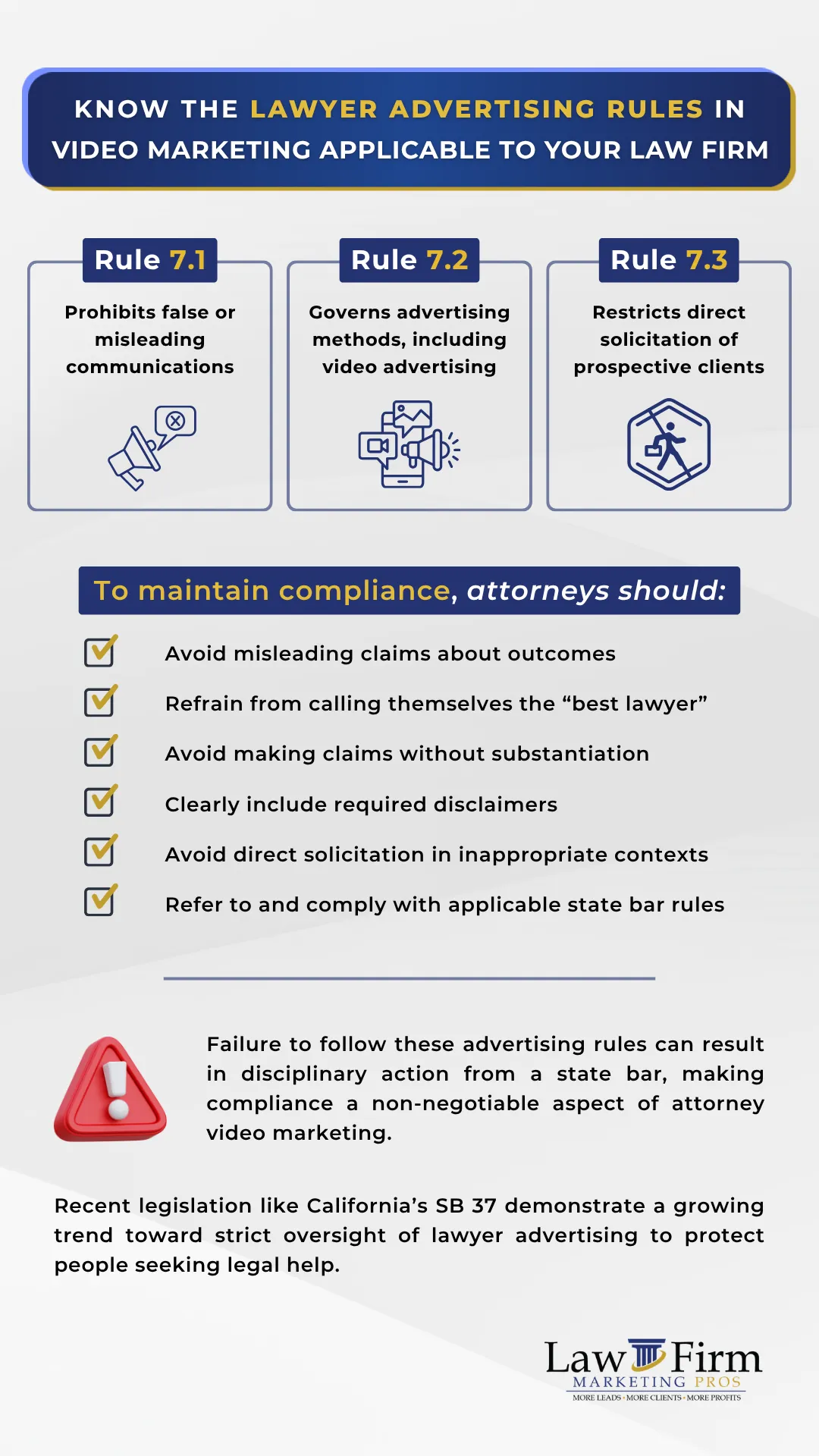
- Rule 7.1: Prohibits false or misleading communications
- Rule 7.2: Governs advertising rules (including video marketing) and communications regarding services and specialization
- Rule 7.3: Restricts direct solicitation of prospective clients
These ABA rules form the foundation, but each state bar enforces its own specific lawyer advertising rules for video marketing. Attorneys must always check local rules before publishing legal videos.
What This Means for Video Content
To maintain compliance, attorneys should:
- Avoid misleading claims about outcomes
- Refrain from calling themselves the “best lawyer”
- Avoid making claims without substantiation
- Clearly include required disclaimers
- Avoid direct solicitation in inappropriate contexts
Failure to follow these advertising rules can lead to disciplinary action from a state bar, making compliance a non-negotiable aspect of attorney video marketing.
There is a growing trend toward stricter oversight of attorney advertising, particularly in digital formats like video. While specific provisions vary by jurisdiction, the broader impact is clear across the United States. California’s recent SB 37 illustrates this increased emphasis on protecting prospective legal clients from unclear or misleading information, requiring the specific law firm or an attorney at the firm to be clearly identified, along with address information.
The strict penalties bring these compliance considerations into sharper focus when planning, producing, content for attorneys and law firms before proceeding with the steps of publishing and distributing video assets.
High-Level Impacts on Video Marketing
- Increased scrutiny of client testimonials and endorsements
- Greater emphasis on identifying information in advertisements
- Definitions of what constitutes direct solicitation
- Heightened enforcement around misleading claims
For law firms, this means video marketing must be approached with a compliance-first mindset. Even short-form video ads on a social media platform may be subject to the same rules as traditional advertising.
Ethical Video Marketing for Law Firms: What You Must Do
Ethical video marketing for law firms is not just about avoiding penalties, it’s about building long-term trust with your intended audience.
Avoid Misleading Claims and Unrealistic Expectations
Attorneys should never:
- Guarantee results
- Suggest outcomes are typical when they are not
- Overstate experience or success rates
Misleading claims not only violate ethical obligations, but also damage credibility with potential clients.
Understand the “7 Forbidden Words”
Many state bar guidelines restrict certain types of language that could mislead consumers. Phrases implying superiority or guaranteed success can trigger compliance issues.
Attorneys should avoid using problematic terms like:
- “Best”
- “Expert” (without certification)
- “Guaranteed”
We have specified 7 forbidden words and variations to avoid in legal marketing and advertising in order to remain compliant, and law firms should refer to their own state bars for specific applicable rules. These restrictions exist to protect consumers and make sure that legal services are marketed truthfully.
Use Client Testimonials Carefully
Client testimonials can be powerful, but they must be handled properly. Law firms must disclose if any compensation was provided for client testimonials or endorsements included in their videos. Law firms must also avoid making comparisons to the services provided by other lawyers or law firms that cannot be factually substantiated in their video content.
Protecting client confidentiality is a fundamental ethical obligation for lawyers in video marketing. Law firms must ensure that no confidential client information or details about specific cases are revealed in the videos without proper consent and authorization.
Law firms must implement an internal review and approval process for all video content to ensure compliance with ethical and professional standards before publishing or distributing the videos.
Testimonial videos should enhance credibility, not create compliance risks. Make sure your processes address these considerations:
- Include disclaimers if required
- Avoid creating unjustified expectations
- Make sure statements are truthful and verifiable
Protecting client confidentiality is a fundamental ethical obligation for lawyers in video marketing.
Law firms must disclose if any compensation was provided for client testimonials or endorsements included in their videos.
SB 576 and Impact for Streaming Video Ads in California
California’s SB 576, the “No More Loud Commercials” law, requires video streaming services to make sure that commercials are not louder than the surrounding content. This applies the federal CALM Act to streaming services, requiring the volume of ad content to be lowered to the level of the surrounding content.
SB 576 goes into effect July 1, 2026. While this law places the burden on the streaming platforms and services presenting the advertisements among other surrounding content, law firms producing video content should nevertheless adhere to best practices and set audio levels at reasonable levels before publishing and distributing their videos. This can help to avoid technical modification, delays, or rejection on these platforms.
Building a Compliant and Effective Video Strategy
A successful law firm video strategy blends creativity with structure. It requires intentional planning around both marketing strategy and legal compliance.
Choose the Right Video Topics
Effective video topics include:
- Quick legal tips (not specific legal advice)
- Explanations of the legal process
- FAQs about specific practice areas
- Updates on changes in the legal field
These types of informative videos provide value while positioning your firm as a trusted resource.
Focus on Your Target Audience
Your target audience should guide every decision:
- What legal questions are they asking?
- What concerns do they have?
- What stage of the decision-making process are they in?
By aligning your video content with your intended audience, you increase engagement and reduce the risk of losing viewer interest.
Keep Branding Consistent
Your firm’s branding should remain consistent across all video content:
- Visual identity (colors, logos, tone)
- Messaging aligned with your firm’s services
- Professional presentation suited to a professional audience
Strong branding helps law firms stand out in a crowded digital landscape.

Where and How to Use Video Content
Distribution is just as important as production. Law firms should embed videos across multiple channels to maximize visibility.
Website Integration
- Embed videos on service pages
- Use video on landing pages for lead generation
- Enhance blog posts with relevant legal videos
Embedding video on service pages improves user engagement and supports search engine performance.
Social Media and Digital Platforms
Law firms should leverage:
- Social media accounts
- Video ads on platforms like YouTube and Facebook
- Other platforms where their audience spends time
Publishing video across digital platforms promotes broader reach and helps generate leads.
Paid Advertising and Search Visibility
Video ads can also be integrated into:
- Google Ads campaigns
- Retargeting strategies
- YouTube pre-roll advertising
These approaches help law firms attract new clients and convert viewer interest into paying clients.
Creating Engaging and Compliant Legal Videos
Creating content that resonates while staying compliant often requires a thoughtful approach.
Structure Matters
To keep viewer interest:
- Start with a clear hook
- Address a specific legal question
- Provide actionable insights
- End with a compliant call-to-action
Avoid Direct Solicitation Pitfalls
Direct solicitation rules apply differently depending on the context. Attorneys should:
- Avoid targeting vulnerable individuals
- Make sure outreach is not coercive
- Follow state bar guidelines for communication
Maintain a Human Connection
Even in a highly regulated environment, video allows law firms to build an emotional connection with potential clients. The human element, tone, delivery, and authenticity, can set your firm apart.
Advanced Strategies to Stand Out in 2026
As competition increases, law firms must go beyond basic video marketing.
Combine Video with SEO
Video enhances search engine visibility by:
- Increasing time on page
- Improving engagement metrics
- Supporting rankings in search results
When properly optimized, video can appear directly in Google search results.
Repurpose Content Across Channels
A single video can be:
- Edited into short clips
- Shared across social media
- Embedded into blog posts
This comprehensive approach maximizes ROI from each piece of content.
Use Data to Refine Your Strategy
Track performance metrics such as:
- Viewer retention
- Click-through rates
- Conversion rates
These insights help refine your video marketing efforts over time.

FAQs About Video Marketing for Attorneys
Are there ABA rules or state bar rules regarding video marketing for lawyers?
Yes, video marketing is allowed, but attorneys must comply with ABA rules and state bar advertising rules.
What disclaimers are required in legal videos?
Disclaimers vary by jurisdiction but often include statements that results are not guaranteed and that the content is for informational purposes only.
Can lawyers use client testimonials in videos?
Yes, but client testimonials must be truthful, not misleading, and may require disclaimers depending on state bar rules.
What makes a legal video misleading?
Any content that creates unjustified expectations, omits critical information, or exaggerates results may be considered misleading. Refer to the applicable bar rules for your state(s).
Do social media videos count as attorney advertising?
Yes, videos on social media platforms are generally considered advertising, and they must follow applicable rules.
How can law firms maintain compliance in video marketing?
Remain compliant by reviewing ABA rules, checking state bar guidelines, and implementing a compliance review process before publishing videos.
What types of videos work best for law firms?
Educational videos, FAQ videos, and short-form content addressing common legal questions often tend to perform well when the relevant content, production, publishing, and distribution are executed well.
How often should law firms publish videos?
Consistency matters more than frequency. Regular publishing builds authority and audience trust.
Balancing Growth and Compliance
Video marketing offers law firms a powerful way to reach a new audience, explain complex legal concepts, and build meaningful connections with potential clients. However, success requires more than just creativity. It demands a disciplined, compliance-focused approach.
Law firms that invest in thoughtful, ethical video marketing strategies will not only stand out but also establish credibility in an increasingly competitive digital environment. As regulations evolve and platforms change, having a clear framework and the right guidance can make all the difference in turning video into a sustainable growth engine.
Join the elite law firms who trust Law Firm Marketing Pros and our proprietary Law Firm Client Generation System™. We’ll promote your law firm’s brand, create a hyper-optimized law firm website, and handle everything from web design to content marketing and law firm SEO incorporating AEO/GEO to the creation of a legal marketing funnel that drives qualified leads.
At Law Firm Marketing Pros, we partner with aggressive growth-minded attorneys seeking more cases by getting their digital marketing right. Result: Make more money, reclaim valuable time, and focus on what matters most.
Contact Partner and Co-Founder Josh Konigsberg, author of Law Firm Digital Marketing Made Easy: The Only Book You’ll Ever Need to Become a Best-Known Attorney, to schedule a free 15-minute client accelerator call at (561) 948-5001 or complete our online form.
Though brief, this call dives deep into your strategy. Josh will then prepare a complimentary digital marketing brief packed with 25-35 pages of value that drives qualified clients directly to your practice.
Copyright © 2026. Law Firm Marketing Pros. All rights reserved.
This blog is not intended to be legal advice for a lawyer or law practice. No special relationship or privilege exists between you and the Blog and/or its owners, Law Firm Marketing Pros, or its Affiliates (“LFMP”). LFMP IS NOT A LAW FIRM, and THE AUTHOR IS NOT AN ATTORNEY. You will be representing yourself and your law practice in any legal matter you undertake or any Client you represent as a result of your use of the information provided in the Blog, including any Services offered through the Blog and content available on the Site the Blog is published on and in all other matters relating to you and your businesses. This Blog may provide audio-video content, referenced articles, newsletters, and other content for informational purposes only. In the process of providing this information, the Blog is engaged in the publication of information regarding business and management issues that may be commonly encountered by law firms. This blog is not a substitute for the advice of an attorney. This Blog does not review any of your answers to questions for sufficiency, provide legal advice, or analyze applicable law and apply it to your specific requirements. Accordingly, if you need legal advice for a specific issue, you are advised to seek the advice of your local, state, and/or national Bar Association.
Law Firm Marketing Pros
250 S. Central Blvd, Suite 100-A
Jupiter, FL 33458
561-948-5001
https://lawfirmmarketingpros.com/