
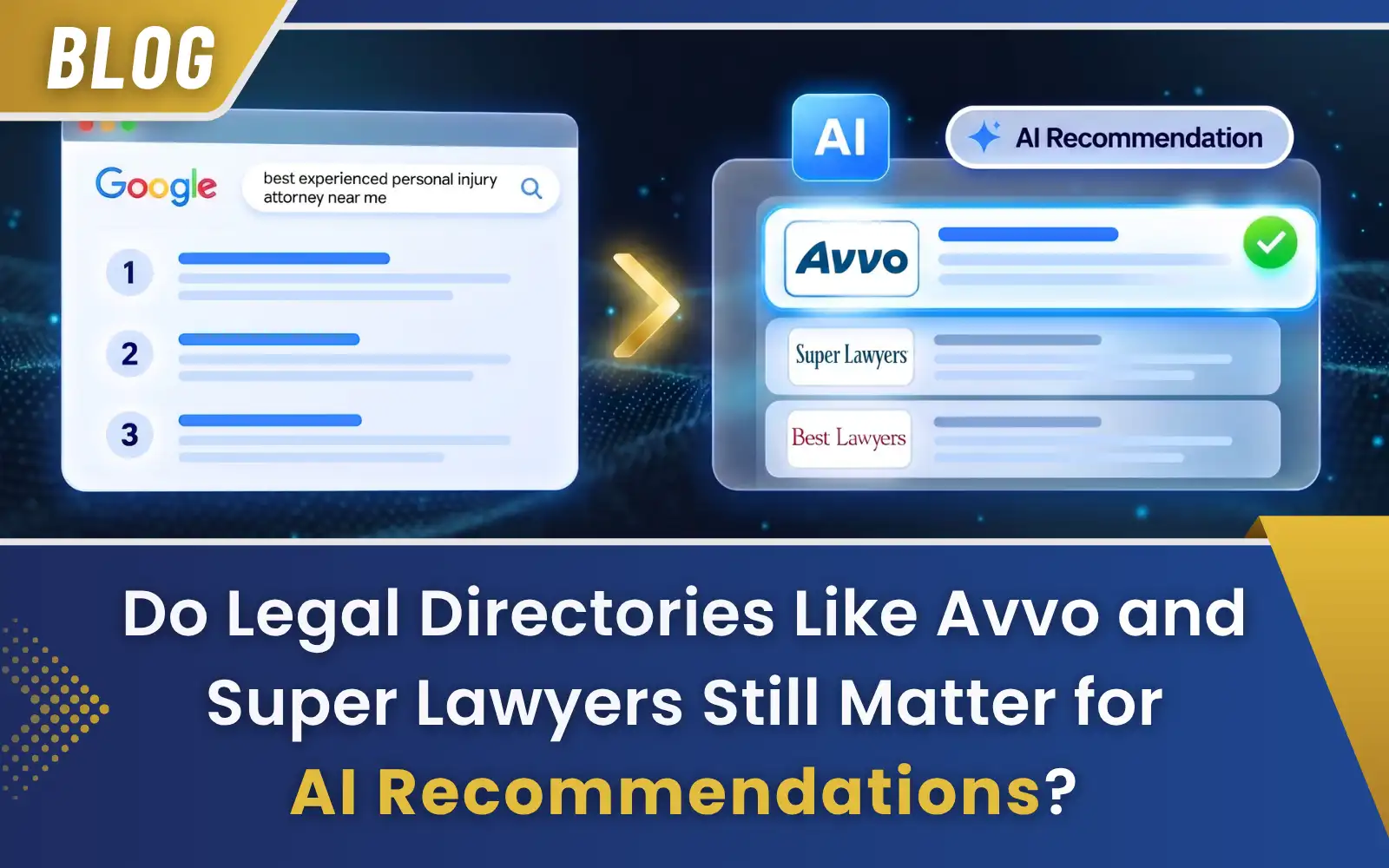
Why Legal Directories Still Matter in a Changing Search Landscape
For years, law firms have invested in legal directories, professional recognition, client reviews, and online profiles to build credibility and attract potential clients. Platforms such as Avvo, Super Lawyers, and Best Lawyers have helped attorneys present their credentials, demonstrate professional standing, and become more discoverable beyond their own websites.
Today, the question is no longer simply whether these platforms help lawyers appear in traditional search results. It is whether legal directories and AI recommendations are connected, and what that relationship means for law firm marketing in an environment shaped by ChatGPT, Google AI Overviews, Perplexity, and other AI-assisted search tools.
The short answer is yes, legal directories can still matter. However, their value varies by platform, query, practice area, and the information available from other sources. A directory profile may provide useful information about an attorney, while an AI-generated answer may rely on a firm’s website, professional recognition, client reviews, news coverage, or several sources together. A citation does not prove that a directory caused a recommendation, and a profile does not guarantee visibility.
For growth-minded attorneys, the practical objective is to build a credible, consistent online presence that helps people understand who the firm serves, what its lawyers do, and why their qualifications are relevant. That requires more than claiming a profile or accumulating ratings. It calls for a coordinated strategy across the firm’s website, search visibility, reputation management, and third-party sources.
Discover how legal directories and AI recommendations intersect, and how law firms can improve AI search visibility, credibility, and online reputation.
Key Takeaways
- Legal directories remain useful components of a law firm’s digital presence, but their value differs by platform and objective.
- AI search visibility for law firms depends on a broader information ecosystem, including the firm’s website, professional credentials, online reviews, and relevant third-party sources.
- Avvo, Super Lawyers, Best Lawyers, and other legal directories serve different purposes. Their value should be assessed individually rather than treated as interchangeable.
- Accurate profiles, consistent attorney information, useful website content, and responsible reputation management are practical priorities.
- Law firms should distinguish AI citations and mentions from referral traffic, qualified inquiries, and signed clients.
- AI-literate marketing professionals can help attorneys evaluate evidence, coordinate channels, and adapt strategies without relying on speculative AI optimization promises.

What AI Recommendations Mean for Law Firms
AI recommendations are generated responses that identify, describe, compare, or suggest attorneys and law firms in response to a user’s question. Unlike a traditional list of search results, an AI response may synthesize information from multiple sources and present a short explanation before the user visits a website.
A person might ask, “Who handles complex commercial litigation in Chicago?” Another might ask, “How do I find a Florida attorney experienced with serious truck accident claims?” These are different from a general search for law firms. They combine a legal need with a location, practice area, or specific qualification.
When answering legal questions, AI tools may draw on accessible website content, professional profiles, directory listings, reviews, public records, and other material. The sources available and selected can vary with the platform, the wording of the question, and whether the system retrieves current web information.
This creates several opportunities for law firms. A well-maintained digital presence can help prospective clients verify an attorney’s qualifications, understand the firm’s services, and find information that supports an informed decision. At the same time, incomplete or inconsistent information can make it harder for people and automated systems to distinguish one attorney from another.
AI recommendations are not a single ranking system. Google AI Overviews, ChatGPT, and Perplexity have different products, retrieval behaviors, and source-selection processes. A firm mentioned by one tool may not appear in another. Marketing strategies should reflect that variability rather than assume that one directory or optimization technique works everywhere.
Which Legal Directories Matter Most for AI Search?
Not all directories serve the same purpose, and a firm’s priorities should reflect the type of clients it wants to serve. A consumer-facing personal injury firm may benefit from different platforms than a business litigation firm pursuing sophisticated corporate clients. The objective is to identify credible sources that align with the firm’s practice, audience, and market.
Justia, Avvo, FindLaw, Lawyers.com, Martindale-Hubbell, Super Lawyers, Best Lawyers, and Nolo are among the legal directories appearing in AI answers. At least one legal directory is typically cited in approximately half of AI responses. Super Lawyers, Avvo, and Justia often have the highest overall citation counts among these platforms.
These findings provide useful direction, but they should not be interpreted as a universal ranking of directory value. The studies examine particular queries, dates, and platforms. They measure observed citations, not the incremental business value of maintaining a listing.
Avvo: Attorney Profiles, Ratings, and Reviews
Avvo has historically provided attorney biographies, practice information, ratings, and client reviews. For lawyers, a complete profile can give prospective clients another source for checking professional information and understanding an attorney’s background.
The value of an Avvo listing depends on more than whether an AI tool cites the site. Attorneys should review the accuracy of their biographies, practice areas, locations, contact information, and publicly displayed ratings. They should also examine whether the profile communicates the kind of work the firm actually handles.
An important caveat is that access to directory content can change. AI platforms may use live web retrieval, other accessible sources, or information already available to them. A directory’s appearance in one study does not mean every AI system can access every profile at all times.
Super Lawyers: Professional Recognition
Super Lawyers provides a professional recognition platform that may help attorneys communicate peer recognition and professional standing. Recognition can contribute to a lawyer’s public profile, particularly when it is relevant to the practice area and accurately described.
Firms should present awards in context. If an attorney has been recognized by Super Lawyers, the firm’s website can explain the recognition, its year, and the relevant category. The same information can be reflected in the attorney’s biography and other profiles where appropriate.
A badge alone offers limited explanatory context. Accurate text describing the recognition helps human readers understand what it represents. It also creates a clearer connection between the attorney’s name and the credential.
Recognition is not a substitute for evidence of relevant experience, a clear description of services, or a useful website. Nor does an award guarantee that an attorney will appear in an AI-generated recommendation.
Best Lawyers: Credentials and Professional Standing
Best Lawyers offers another form of professional recognition. Its relevance depends on the attorney, category, geography, and the questions prospective clients are asking.
For firms pursuing complex commercial work or high-value matters, professional recognition may contribute to a broader picture of a lawyer’s qualifications. The firm’s website should describe credentials accurately and avoid suggesting that recognition in one category establishes suitability for every matter.
The same principle applies to other professional platforms: maintain accurate profiles, explain recognition clearly, and assess whether the platform reaches the audiences that matter to the firm.
Justia, FindLaw, and Other Legal Directories
Justia and FindLaw provide additional avenues for publishing attorney information and connecting people with legal resources. Martindale-Hubbell and Lawyers.com may also be relevant, depending on the firm’s market and objectives.
The right strategy is not to pursue every directory indiscriminately. Start by identifying established platforms relevant to the firm’s practice area, geography, and reputation. Then compare profile completeness, available features, referral activity, and maintenance costs.
Free listings may be worthwhile when they are accurate and reasonably easy to maintain. Paid advertising requires a separate business case. A directory’s visibility in AI answers is a reason to investigate its potential value, not sufficient evidence to justify a substantial advertising commitment.
How AI Platforms Interpret Legal Directory Information
AI search visibility for law firms is shaped by multiple sources and processes, rather than a single universal directory ranking. A firm’s own website, public professional profiles, business listings, client reviews, and independent coverage can all contribute to the information available to people researching attorneys.
The practical task is to make the firm’s identity and qualifications clear, consistent, and verifiable wherever they are described.
Google AI Overviews and Google Search
Google’s published guidance emphasizes established SEO fundamentals for eligibility in AI Overviews and AI Mode. A website must meet the relevant technical requirements for Google Search, and there is no special AI schema or separate optimization formula that guarantees inclusion.
For a law firm, that means maintaining an accessible website with useful attorney biographies, clear practice-area pages, accurate business information, and relevant supporting content. Directory profiles can complement that foundation, but they do not replace it.
Google Business Profile should also be treated separately from legal directories. For firms serving local markets, accurate business details and authentic client reviews can support the wider local presence that prospective clients encounter during their research.
ChatGPT, Perplexity, and Other AI Tools
AI tools like ChatGPT and Perplexity may provide answers grounded in current web sources, depending on the product and mode of use. Their citations can differ even when users submit similar questions. The wording of the prompt, the geography involved, the available sources, and product changes may all affect the response.
There are substantial differences in how platforms cite legal directories and law firms, which is one reason why law firms should not rely on one platform or one test query to judge their visibility.
A sensible monitoring process tests several realistic prompts across multiple tools. For example, a firm might examine how an AI system describes its attorneys, which sources it references, and whether it correctly identifies the firm’s practice areas and service locations. Those observations should be recorded with the date and platform so that changes can be assessed over time.
How to Audit Legal Directory Listings for Law Firms
A directory audit is a practical starting point for improving consistency and reducing avoidable gaps in a firm’s digital presence. The work should cover both individual attorney profiles and firm-level listings because prospective clients may search for either.
Begin with a master record of the firm’s official name, addresses, phone numbers, website, practice areas, attorney biographies, credentials, and service locations. Compare that record with the firm’s website, Google Business Profile, and relevant directories.
Then review each profile for completeness, accuracy, and relevance. Correct outdated information, remove duplicate profiles where possible, and confirm that links lead to the intended pages. Where a directory permits detailed descriptions, use clear language to explain the attorney’s practice and relevant qualifications.
Do not manufacture awards, inflate experience, or create artificial client reviews. A credible reputation depends on accurate information and legitimate professional standing, not the volume of promotional claims.
A Practical Directory Audit Checklist
- Confirm the attorney’s full name, firm affiliation, contact information, and location.
- Review practice areas and make sure they accurately reflect the work the attorney handles.
- Verify bar admissions, education, professional memberships, and recognition.
- Check that links lead to the correct website and attorney biography.
- Review client reviews for accuracy, relevance, and appropriate responses.
- Identify duplicate, outdated, or incomplete listings.
- Record whether the directory provides meaningful referral traffic or qualified inquiries.
- Review paid listings separately from free profiles and compare their costs with measurable value.
- Recheck important profiles periodically and after significant firm changes.
A firm can use this checklist internally, but larger practices may benefit from assigning ownership to a marketing team or agency that can coordinate updates across multiple platforms.
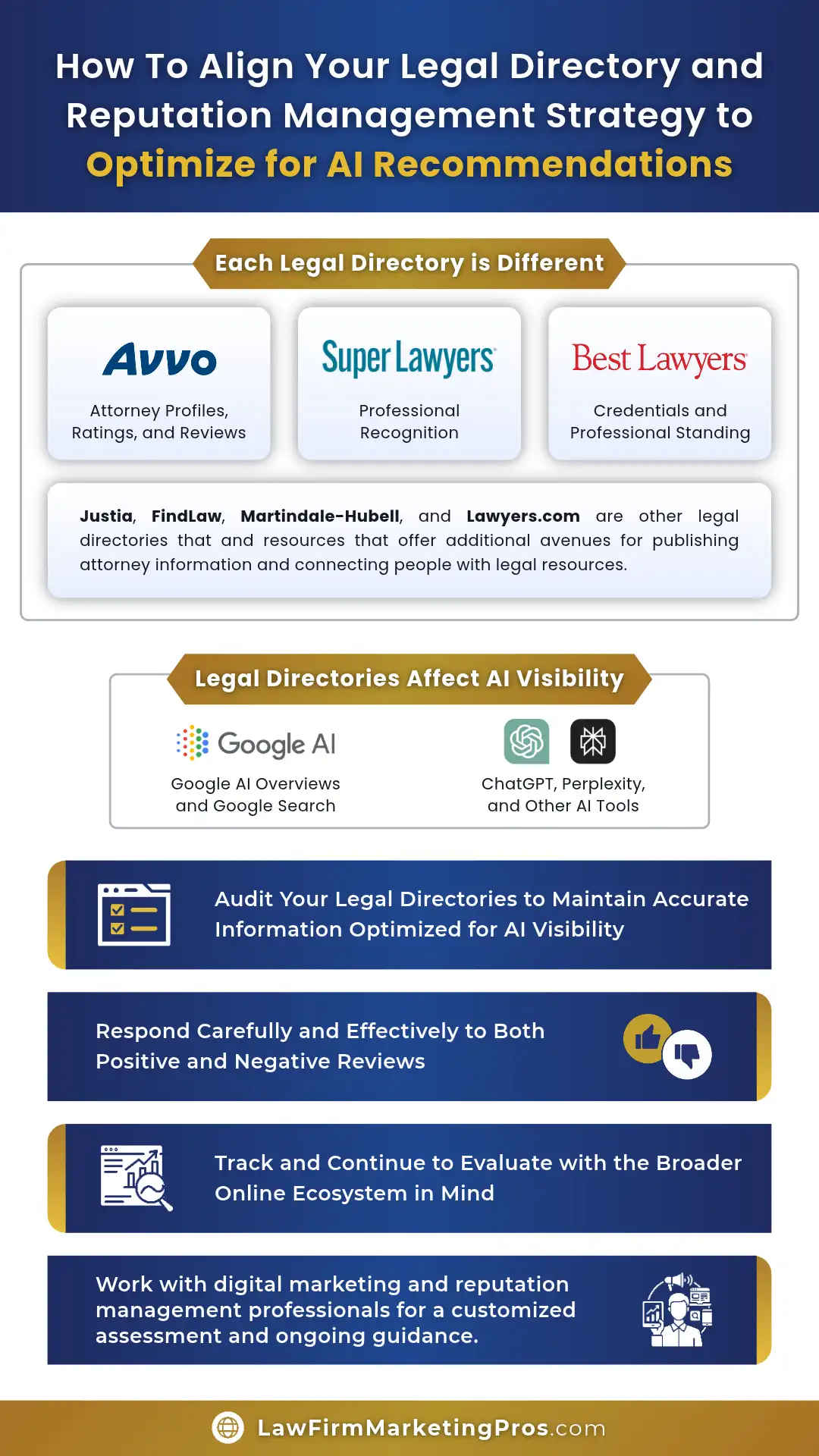
Why Online Reviews and Reputation Management Matter
Legal directory listings are only one part of a firm’s reputation. Client reviews, professional recognition, public information, and the firm’s own descriptions of its work contribute to how prospective clients assess credibility.
Law firm online reputation management should therefore extend beyond monitoring star ratings. It includes maintaining accurate profiles, requesting feedback appropriately, responding professionally to concerns, and identifying discrepancies that could confuse people researching the firm.
Responding to Positive and Negative Reviews
Positive reviews can provide useful context about a client’s experience, including communication, responsiveness, and professionalism. However, firms should not pressure clients to provide favorable feedback or offer incentives in ways that conflict with platform rules or professional obligations.
A negative review deserves a measured response. Attorneys should avoid disclosing confidential information, discussing disputed facts publicly, or making comments that could undermine a client’s privacy. Depending on the circumstances, a brief, professional response inviting the reviewer to contact the firm privately may be appropriate.
Firms should also establish a process for escalating serious allegations, identifying potentially fake reviews, and reporting policy violations through the relevant platform. Not every negative review is fake, and criticism should not automatically be treated as a threat to reputation.
Build a Reputation That Extends Beyond Ratings
A strong reputation management strategy considers the broader information environment. Attorney biographies, published articles, community involvement, professional recognition, accurate directory listings, and a well-maintained website can help present a more complete picture of the firm.
For a law firm serving multiple locations or practice areas, consistency matters. A potential client researching an attorney should encounter compatible information across the firm’s website, professional profiles, and relevant review sites.
Rather than seeking to manufacture a uniformly positive narrative, the aim is to make sure that accurate information about the firm’s experience, services, and professional standing is accessible, while legitimate client feedback is handled responsibly.

How to Measure Directory Value and AI Search Visibility
One of the biggest mistakes in emerging AI marketing is confusing visibility metrics with business outcomes. A directory citation may indicate that a source appeared in an AI response. It does not necessarily mean a potential client saw the response, clicked through, contacted the firm, or retained an attorney.
Measurement should connect visibility with the firm’s actual business objectives.
Track Four Different Types of Evidence
- AI mentions and citations. Record whether the firm or individual attorneys appear in relevant prompts, which sources are cited, and whether the information is accurate. Repeat the same prompt set periodically, recognizing that responses may vary.
- Website and referral activity. Review analytics for referral visits from directories and identifiable AI platforms. Use available attribution data carefully, since some visits may be classified as direct traffic or remain unattributed.
- Qualified inquiries and intake. Ask prospective clients how they heard about the firm and whether they used an AI tool during their research. Intake teams should capture this information consistently without assuming that the first reported source was the only influence.
- Financial value. Compare directory advertising costs with attributable inquiries, qualified opportunities, and retained clients where reliable data is available. Consider the time needed to maintain profiles, not just the advertising fee.
These measures answer different questions. A directory may be useful for professional credibility even if it generates little direct traffic. Conversely, a paid listing may generate visits without producing qualified business. Decisions should reflect the firm’s objectives and available evidence.
Establish a Repeatable Monitoring Process
Create a baseline of the firm’s current visibility across a representative set of legal and business queries. Include branded prompts, practice-area prompts, and location-specific questions that reflect the firm’s target audience.
Record the date, platform, exact prompt, named attorneys or firms, cited sources, and any factual errors. Revisit the same set on a regular schedule, and add new queries when the firm’s priorities change.
Avoid overreacting to a single result. AI answers are variable, and small samples can produce misleading conclusions. Pair these observations with conventional SEO reporting, website analytics, reputation metrics, and intake data to understand whether a broader strategy is contributing to the firm’s business objectives.
Why Law Firms Need AI-Literate Marketing Professionals
The challenge is not simply learning how to use an AI tool. Attorneys and marketing leaders must decide which changes are worth making, which claims are supported by evidence, and how directory activity fits into the firm’s wider growth strategy.
For a busy law firm, monitoring multiple directories, keeping attorney profiles accurate, reviewing client feedback, maintaining a website, and analyzing search visibility can become a fragmented set of tasks. Without coordination, different vendors may make recommendations that conflict or focus on isolated metrics.
An experienced marketing partner can help turn these activities into a manageable process.
Connect Directory Strategy to the Entire Marketing Ecosystem
At Law Firm Marketing Pros, the strategic approach is to consider directory profiles alongside website development, organic SEO, local SEO, reputation marketing, content, and reporting. Each channel serves a different role, but they should support a consistent understanding of the firm’s identity, services, and target markets.
For example, if a firm receives recognition from a professional organization, the marketing team can verify the details, update the relevant attorney biography, review appropriate directory profiles, and determine whether the recognition belongs in supporting content. If a profile contains inaccurate practice information, the team can prioritize correction and check for related inconsistencies elsewhere.
This coordinated approach helps avoid treating each listing as a disconnected marketing asset.
Use AI as a Tool, Not a Substitute for Judgment
AI-literate professionals can use tools to organize directory audits, compare profile information, classify search queries, summarize research, and identify patterns across reports. Human review remains essential, particularly when the information concerns attorney credentials, client feedback, legal services, or professional obligations.
The agency should verify sources, distinguish evidence from assumptions, and adapt recommendations to the firm’s practice area, locations, resources, and growth objectives. Automated tools can make parts of the work more efficient, but they cannot independently establish that a directory investment is commercially worthwhile.
This matters especially in legal marketing, where inaccurate claims, misleading representations, and careless handling of client information can create reputational and compliance concerns.
Focus on Sustainable Improvements Rather Than AI Promises
No agency can responsibly guarantee that a lawyer will appear in a particular AI answer. The more useful commitment is to build a sound digital foundation, improve information quality, monitor meaningful indicators, and adjust the strategy as the market changes.
For aggressive-growth-minded firms, this means prioritizing work that supports the business over chasing every new platform or emerging optimization tactic. A directory deserves attention when its audience, credibility, and measurable contribution justify the effort.

Frequently Asked Questions About Legal Directories and AI Recommendations
These answers summarize the practical implications for attorneys deciding how to manage their digital presence.
Do legal directories still matter for AI recommendations?
Yes. Legal directories are cited in about 50% of AI answers across four leading platforms. This supports continued attention to directories, but it does not establish that all directories matter equally or that citations cause recommendations.
Which legal directories should law firms prioritize?
Start with established platforms relevant to the firm’s practice and audience, including Avvo, Super Lawyers, Justia, FindLaw, and Best Lawyers where appropriate. Consider profile accuracy, recognition, reviews, referral activity, maintenance effort, and cost before deciding where to invest.
Does Avvo help attorneys appear in ChatGPT recommendations?
Avvo appears frequently in ChatGPT results. However, citation patterns can change, and an Avvo citation does not establish that a specific profile caused an attorney to be recommended. Maintaining accurate information is sensible, but visibility is not assured.
Are Super Lawyers and Best Lawyers important for AI visibility?
Both may contribute to the publicly available information about an attorney’s professional recognition. Their practical value depends on the directory, the platform, the query, and the firm’s audience. Describe recognition accurately and do not treat an award as proof of a guaranteed marketing benefit.
Should law firms pay for legal directory listings?
Not automatically. Maintain relevant free profiles when the cost and effort are reasonable. Evaluate paid listings based on audience relevance, referral quality, qualified inquiries, and attributable business value. AI citations alone are not sufficient justification for an advertising purchase.
Are legal directories more important than a law firm’s own website?
No universal hierarchy applies to every firm or AI platform. A firm’s website remains an important source for its services, attorney biographies, locations, and original content. Directory profiles complement that foundation by providing additional sources of information and professional context.
How can attorneys improve AI search visibility?
Maintain accurate attorney and firm profiles, publish useful website content, establish consistent business information, manage reviews responsibly, and monitor representative queries across AI platforms. These practices support a broader digital strategy, but no specific tactic guarantees inclusion in an AI-generated response.
How should law firms respond to negative online reviews?
Respond professionally and avoid disclosing confidential information or debating case details publicly. Investigate legitimate concerns internally, report reviews that violate platform policies, and maintain a consistent process for handling feedback. Reputation management should protect client confidentiality while addressing concerns appropriately.
How often should law firms review their directory profiles and AI visibility?
Review core business and attorney information whenever a material change occurs, and establish periodic checks for important profiles. AI visibility can be monitored quarterly as a starting point, with more frequent reviews when the firm is entering a new market or evaluating a major campaign.
Can a marketing agency guarantee AI recommendations or citations?
No responsible agency should guarantee that a particular AI system will recommend an attorney or cite a specific profile. AI responses vary, and platforms change. An agency can help strengthen the firm’s digital presence, monitor evidence, and manage a coordinated strategy without promising a result it cannot control.
Build a Directory Strategy That Supports Long-Term Growth
Legal directories remain relevant, but they should be evaluated as part of a larger digital marketing strategy rather than treated as a standalone solution. Accurate profiles, credible professional recognition, responsible reputation management, and a useful website help prospective clients research a firm and understand its qualifications.
For growth-minded law firms, the next step is to determine which platforms deserve attention, where information needs improvement, and how those activities connect to qualified inquiries and business goals.
Law Firm Marketing Pros works with attorneys and law firms across the United States to coordinate website development, SEO, reputation marketing, content, reporting, and emerging AI visibility considerations. Our approach combines AI-assisted research and analysis with human judgment, industry knowledge, and personalized attention to each firm’s goals.
If your firm is reassessing its directory presence or trying to understand how AI-assisted search fits into its marketing plans, book a complimentary 15-minute Discovery Call. The conversation can help identify opportunities to evaluate your current digital presence and determine which next steps warrant closer attention. Don’t chase every new AI trend. Instead, make informed marketing decisions, maintain a credible digital presence, and build a coordinated strategy that supports your firm’s long-term growth.
Join the elite law firms who trust Law Firm Marketing Pros and our proprietary Law Firm Client Generation System™. We’ll promote your law firm’s brand, create a hyper-optimized law firm website, and handle everything from web design to content marketing and law firm SEO incorporating AEO/GEO to the creation of a legal marketing funnel that drives qualified leads.
At Law Firm Marketing Pros, we partner with aggressive growth-minded attorneys seeking more cases by getting their digital marketing right. Result: Make more money, reclaim valuable time, and focus on what matters most.
Contact Partner and Co-Founder Josh Konigsberg, author of Law Firm Digital Marketing Made Easy: The Only Book You’ll Ever Need to Become a Best-Known Attorney, to schedule a free 15-minute client accelerator call at (561) 948-5001 or complete our online form.
Though brief, this call dives deep into your strategy. Josh will then prepare a complimentary digital marketing brief packed with 25-35 pages of value that drives qualified clients directly to your practice.
Copyright © 2026. Law Firm Marketing Pros. All rights reserved.
This blog is not intended to be legal advice for a lawyer or law practice. No special relationship or privilege exists between you and the Blog and/or its owners, Law Firm Marketing Pros, or its Affiliates (“LFMP”). LFMP IS NOT A LAW FIRM, and THE AUTHOR IS NOT AN ATTORNEY. You will be representing yourself and your law practice in any legal matter you undertake or any Client you represent as a result of your use of the information provided in the Blog, including any Services offered through the Blog and content available on the Site the Blog is published on and in all other matters relating to you and your businesses. This Blog may provide audio-video content, referenced articles, newsletters, and other content for informational purposes only. In the process of providing this information, the Blog is engaged in the publication of information regarding business and management issues that may be commonly encountered by law firms. This blog is not a substitute for the advice of an attorney. This Blog does not review any of your answers to questions for sufficiency, provide legal advice, or analyze applicable law and apply it to your specific requirements. Accordingly, if you need legal advice for a specific issue, you are advised to seek the advice of your local, state, and/or national Bar Association.
Law Firm Marketing Pros
250 S. Central Blvd, Suite 100-A
Jupiter, FL 33458
(561) 948-5001
https://lawfirmmarketingpros.com/