
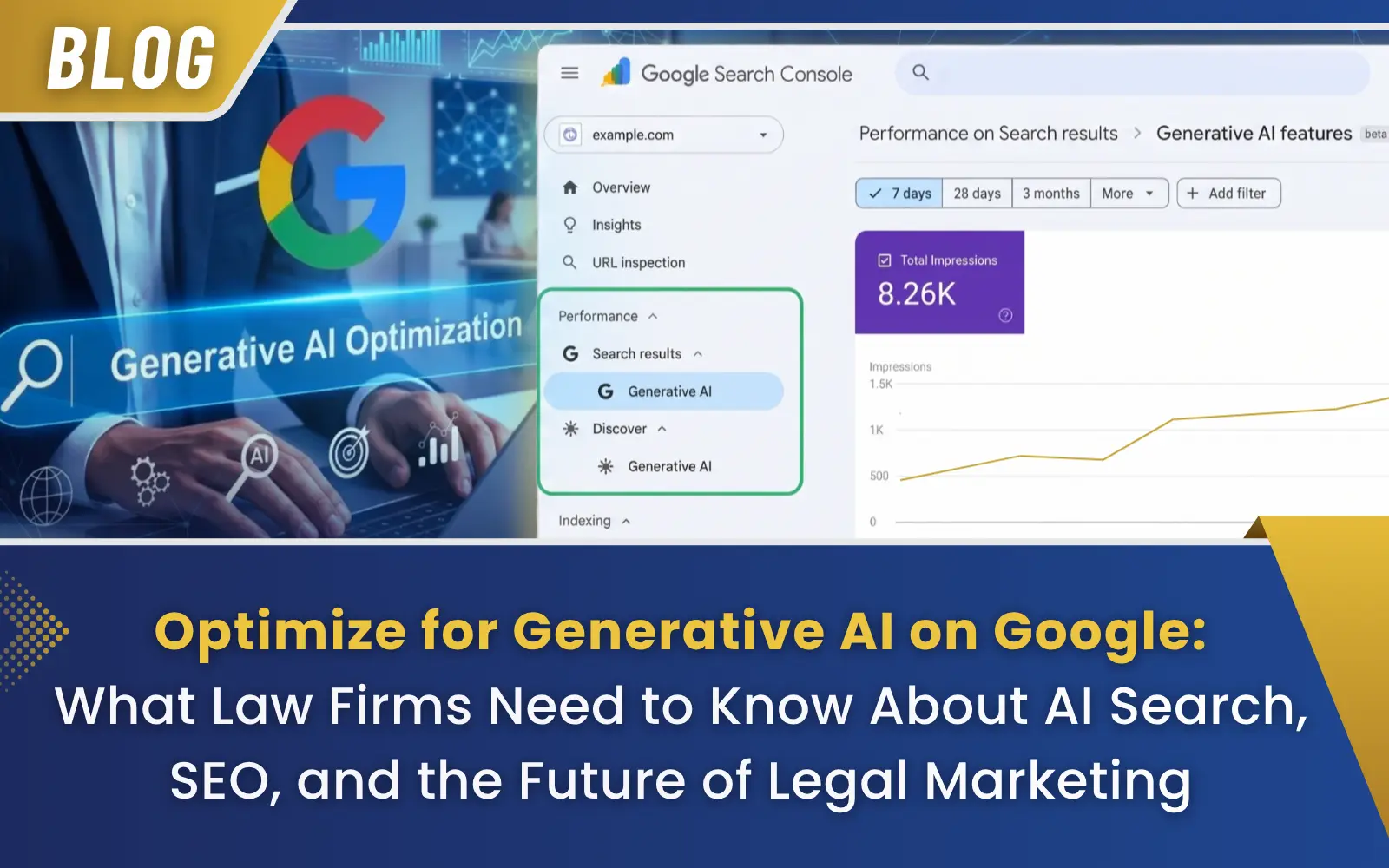
How to Optimize for Generative AI on Google: Preparing Law Firms for the Next Evolution of Search
The way people find information online is changing. For decades, attorneys and law firms have focused on appearing prominently in traditional Google search results through Search Engine Optimization (SEO), strong website content, local SEO, and effective digital marketing strategies. Those fundamentals remain important. However, the introduction of generative AI features such as Google AI Overviews and AI Mode has changed how users interact with Google search and how law firms should think about online visibility.
Google has recently published its guide to optimizing for generative AI features, and true SEO with E-E-A-T emphasis, non-commodity “people-first” content, and avoidance of hacks are at the core of Google’s guidance. Authentic, helpful, informative, and distinct content displayed properly for target audiences is central to online presence, optimization, and strategy. Law firms that want sustainable growth need to understand how to optimize for generative AI on Google while continuing to build the strong SEO foundation that supports visibility across search engines.
For attorneys, this does not mean replacing SEO with a completely new system. Instead, it means adapting SEO strategies to a search environment where Google increasingly provides synthesized answers, conversational responses, and recommendations based on multiple sources. For aggressive-growth-minded law firms, this shift creates both challenges and opportunities. Firms that continue producing generic content, relying only on broad keywords, or using “artificial intelligence” without proper review may struggle to maintain visibility. Firms that invest in authoritative, accurate, people-first legal content supported by experienced marketing professionals can position themselves for long-term success.
Law Firm Marketing Pros works with attorneys and law firms across the United States to develop digital marketing strategies that account for these changes while maintaining the foundation required for sustainable search visibility. Read below to learn how to optimize for generative AI on Google and improve law firm visibility through AI Overviews, AI Mode, law firm SEO, and people-first legal content strategies designed for attorneys.
Key Takeaways
- Google’s AI-powered search features do not replace SEO. Strong SEO remains the foundation for appearing in traditional Google search results and AI-driven experiences.
- Law firms should focus on people-first legal content that demonstrates experience, authority, and practical value rather than simply producing large amounts of AI-generated text.
- Google AI Overviews and AI Mode rely on high-quality, accessible, trustworthy information that satisfies user intent.
- Attorneys should be cautious when using AI tools because legal information changes frequently, ethical rules vary by jurisdiction, and inaccurate content can create professional risks.
- A successful AI search strategy combines technical SEO, original legal insights, local SEO, strong website structure, and ongoing oversight from AI-literate marketing professionals.

What Changed With Google Search and Generative AI?
Google search has always evolved. Algorithm updates, mobile search, featured snippets, voice search, and local search have each changed how businesses approach visibility. Generative AI represents another significant evolution.
Instead of only displaying a list of links, Google increasingly provides AI-generated responses that summarize information from multiple sources. These features are designed to help users find answers more efficiently while still connecting them with websites that provide valuable information.
Google AI Overviews are one example of this change. They appear above traditional search listings for certain queries and provide summarized responses with supporting links.
AI Mode expands this concept by allowing users to interact with Google through more conversational questions. Instead of searching only for short phrases, users can ask detailed questions that resemble conversations with an advisor.
For example, a potential client may previously have searched: “personal injury lawyer near me”.
Now, that same person may ask: “What should I do after a serious car accident if the insurance company denies my claim?”
The second query requires Google to understand context, legal concepts, user intent, and reliable sources.
This creates new considerations for law firms because visibility is no longer only about ranking for individual keywords. It is also about creating content that provides clear, accurate answers to the questions potential clients are asking.
Google’s Guidance: AI Optimization Starts With Strong SEO Foundations
A common misconception is that AI search requires completely different optimization tactics.
Google’s guidance emphasizes the opposite. The same foundational principles that help websites perform well in traditional search remain important for AI-powered search experiences.
A law firm website still needs:
- technically sound SEO
- strong indexing
- clear site structure
- helpful content
- relevant internal links
- accurate business information
- trustworthy authorship signals
- positive user experience
The difference is that AI systems are increasingly evaluating whether content provides meaningful information that can help answer complex questions. For law firms, this reinforces the importance of developing comprehensive resources rather than creating pages designed only around keyword placement.
A page about car accidents, for example, should not simply repeat the phrase “car accident lawyer” throughout the content. It should explain relevant legal concepts, common questions, insurance issues, damages, deadlines, evidence considerations, and the steps someone should consider after a collision.
That approach benefits both traditional SEO and AI-powered search.
Why Law Firms Should Not Treat AI Optimization as a Shortcut
The growth of generative AI has created a flood of tools promising faster content creation and improved rankings. While AI tools can support marketing teams, they cannot and should not be used to replace legal knowledge, editorial judgment, or strategic planning.
One of the biggest risks for attorneys is assuming that more content automatically creates more visibility — particularly when it is thin, AI-generated content.
AI can help teams:
- organize ideas
- analyze topics
- identify common questions
- improve workflows
- assist with research
However, AI-generated content may often lack:
- jurisdiction-specific details
- accurate legal interpretation
- attorney perspective
- practical examples
- appropriate professional tone
- current regulatory awareness
For law firms, these limitations matter to their optimization efforts because legal information is considered a high-trust category. Users are not simply looking for general information. They are often making decisions involving finances, family matters, health, safety, or legal rights. The content attorneys and law firms publish needs to be reliable and trustworthy.
Google’s emphasis on experience, expertise, authoritativeness, and trustworthiness (E-E-A-T) is especially relevant for legal websites.
The Importance of People-First Legal Content in AI Search
The concept of people-first legal content is becoming increasingly important as AI systems improve.
Many websites can produce basic explanations of legal topics. The challenge is creating content that demonstrates why a particular law firm is a credible source of information.
Strong legal content should answer:
- What questions are potential clients asking?
- What misconceptions commonly exist?
- What practical steps should someone consider?
- What legal factors may affect their situation?
- What information helps someone make an informed decision?
For example, a generic article titled “How Long Do Personal Injury Cases Take?” may provide some basic information, but it cannot provide an accurate answer without accounting for variation among cases. A stronger resource explains:
- why timelines vary
- how medical treatment affects claims
- how insurance companies evaluate cases
- how evidence affects negotiations
- when litigation may become necessary
- why state law differences matter
The second approach provides more value because it reflects actual legal experience rather than a surface-level summary. This type of content gives Google and AI systems more context when determining whether a page is a useful source.
Understanding the Relationship Between SEO, AEO, GEO, and AI Search
The growth of AI search has introduced several terms, including:
- Answer Engine Optimization (AEO)
- Generative Engine Optimization (GEO)
- AI SEO
- AI Search Optimization
These concepts describe efforts to make content easier for AI systems and answer platforms to understand. However, law firms should avoid viewing them as replacements for SEO. A strong digital marketing strategy connects all of these concepts.
Traditional SEO helps ensure that a website is:
- crawlable
- indexable
- technically healthy
- relevant to user queries
AEO focuses on answering specific questions clearly. GEO focuses on improving the likelihood that content is considered in generative AI responses. The foundation remains the same: creating accurate, useful, authoritative information for users.
For attorneys, this means continuing to invest in:
- practice area pages
- attorney bio pages
- legal blogs
- local SEO
- Google Business Profile optimization
- reputation management
- technical website improvements
AI search adds another layer, but it does not eliminate the fundamentals that have historically supported successful law firm SEO.
How Generative AI Changes Legal Marketing Strategy and What Law Firms Need to Do Next
AI Search Requires a More Strategic Approach to Law Firm SEO
As Google continues integrating generative AI into search experiences, law firms should view AI as an evolution of their existing marketing strategy rather than a replacement for proven SEO principles.
The firms most likely to benefit from these changes will be those that understand how AI systems evaluate information, how prospective clients search for legal help, and how strong digital foundations influence visibility.
Traditional law firm SEO focused heavily on ranking individual pages for specific queries. That remains important, but AI-powered search places greater emphasis on whether a website provides complete, reliable answers across an entire topic.
A successful SEO strategy for a law firm increasingly requires a connected ecosystem of content:
- comprehensive practice area pages
- supporting legal blogs
- attorney bio pages
- location-specific content
- FAQs
- authoritative external references
- internal links connecting related information
For example, a personal injury law firm should not only have a page targeting “personal injury lawyer.” It should usually also provide supporting resources addressing practice areas and concerns like:
- car accidents
- truck accidents
- motorcycle accidents
- insurance disputes
- medical treatment
- settlement processes
- evidence preservation
- deadlines under applicable law
This interconnected approach helps search engines and AI systems understand the firm’s areas of knowledge.
Why AI-Generated Legal Content Requires Careful Oversight
“Artificial intelligence” has become a valuable tool for marketing teams, but law firms face unique challenges when using AI. Unlike many other industries, legal services involve rapidly changing regulations, jurisdictional differences, ethical requirements, and professional responsibility concerns.
A response generated by an AI tool may appear accurate while containing:
- outdated statutes
- incorrect procedural information
- inaccurate deadlines
- missing exceptions
- incorrect jurisdictional assumptions
- unsupported legal conclusions
These risks can be especially significant because legal information often changes through:
- legislative updates
- court decisions
- administrative rules
- changes in professional responsibility guidance
- local procedural requirements
A law firm using AI-generated content without appropriate review may unintentionally publish information that creates confusion for users or raises compliance concerns.
Unexpected AI Pitfalls for Lawyers and Law Firms
AI May Create False Confidence
One of the most significant risks is that AI-generated content often sounds authoritative even when information is incomplete. Attorneys are accustomed to reviewing legal arguments, evidence, and authority. Marketing content requires the same attention. A law firm should not assume that an AI-generated article is accurate simply because it is written well. An auto-generated confident tone does not mean the information conveyed is true.
Each published legal resource should be carefully reviewed for:
- accuracy
- jurisdiction
- current law
- appropriate disclaimers
- professional responsibility considerations
AI May Remove the Human Perspective That Builds Trust
Many firms may begin publishing large volumes of AI-created articles. This creates a challenge because generic information becomes easier to produce.
When every law firm can publish similar explanations, differentiation at first becomes more difficult. However, it also creates an opportunity for firms that are willing to invest in a strong content strategy.
The strongest websites will continue emphasizing:
- attorney experience
- firm philosophy
- unique insights
- examples from practice
- explanations of common client concerns
- attorney-reviewed information
AI can help as part of a process to create content more efficiently, but it cannot replace the value of actual legal experience.
AI May Create Ethical Concerns for Attorney Marketing
Attorney advertising rules continue evolving as technology changes.
Law firms should consider:
- whether AI-generated statements are accurate
- whether claims about experience are supported
- whether content creates unreasonable expectations
- whether AI-generated assets convey authenticity
- whether jurisdiction-specific advertising rules apply
- whether disclaimers are needed
Different states may approach technology and attorney advertising differently. A marketing approach that works in one jurisdiction may require adjustments elsewhere.
This is why attorneys should combine AI tools with careful human oversight from professionals who understand both digital marketing and the legal industry.

Creating Content that AI Systems Can Understand and Users Can Trust
AI search depends on understanding context.
A law firm website should make information easy for both users and AI systems to interpret.
This begins with strong website organization.
Build Comprehensive Practice Area Pages
Practice area pages remain among the most valuable pages on a law firm website.
A strong practice area page should explain:
- the legal issue
- common situations involving the issue
- how the legal process works
- relevant factors affecting a claim or matter
- common questions
- when someone should contact an attorney
For example, a page about car accidents should not only target a phrase like “car accident lawyer.”
It should answer questions such as:
- What should someone do after a collision?
- What insurance coverage may apply?
- How are injuries documented?
- What happens if another driver disputes fault?
- How do state laws affect the claim?
This type of comprehensive information creates stronger signals for SEO and AI visibility.
Strengthen Attorney Bio Pages
Attorney bio pages are another important opportunity. Many law firms underestimate the value of attorney profiles because they focus primarily on service pages. However, AI systems and users both look for credibility signals.
Strong attorney bio pages should include:
- legal background
- practice areas
- professional experience
- education
- bar admissions
- publications
- speaking engagements
- community involvement
- personal perspective where appropriate
- accurate language compliant with applicable regulations
A detailed attorney bio helps connect a law firm website with real people rather than anonymous content. AI tools can be used to help law firms improve and maintain attorney bio content, but this should only be done with the coordination and approval of the attorney(s) or staff member(s).
The Importance of Coordination and Approval
For written and visual bio representations best practices are to coordinate with the employee and gain appropriate approval at every material stage for written and visual representations. A coordinated process that treats employees as people rather than marketing assets helps protect accuracy, credibility, E-E-A-T, employee relationships, and the firm’s long-term reputation.
The dangerous misstep of using AI-generated variations of a real employee’s likeness without that person’s informed and direct approval can create substantial legal, ethical, HR, trust, and SEO/AEO risks. An employee voluntarily providing an authentic photograph and agreeing to its approved use is distinct from taking liberties with that person’s image, appearance, voice, or identity to create an AI-generated representation to match or fulfill perceived business interests.
Above all, empathy should be part of the approval process: If an employee says that an AI-generated likeness does not represent them or that they do not want it used, the appropriate response is to listen, pause, and work toward a mutually acceptable solution rather than assuming marketing objectives override their concerns.
If Considering AI Bio Photo Editing, Approval and Consent at Each Step is Key
Many will naturally strongly oppose use of AI tools to manipulate their bio photos, and they may also oppose uploading their likenesses to be used as references by generative engines, but it remains an option that some professionals and staff may be open to pursuing.
If AI bio photo editing is being considered:
- Respect whether an employee wants AI used for photo editing, or whether they are comfortable having their likeness uploaded to a given AI platform. This should be addressed without force or intimidation.
- Explain what would be created and where it would appear or be used as an input.
- Do not proceed without direct approval of such assets and their uses at each material step.
- Promptly correct or remove material when an employee objects.
Changing laws, employment considerations, privacy expectations, professional-conduct rules, and platform algorithms can create additional risks of harm over time. An unauthorized manipulated likeness can undermine authenticity, drastically reduce employee morale, harm reputation, and work against the people-first principles that increasingly matter to E-E-A-T and generative search. AI fatigue and distrust over concerns regarding misuse of personal information contribute to legal and algorithmic changes, which can affect your firm. Remember that your daily operations depend on these people. Respect your firm’s team members like you would respect a top client.
Local SEO Remains Important in AI Search
Many legal searches have local intent.
Someone searching for legal assistance is often looking for an attorney who serves a specific area.
Local SEO continues to influence visibility through:
- geographic relevance
- business information accuracy
- reviews
- local citations
- Google Business Profile optimization
For example, someone searching for “personal injury lawyer near me” is not simply looking for general information. They are looking for available legal services in their area.
A strong local SEO strategy includes:
- accurate office information
- consistent business listings
- location-specific website content
- relevant local links
- strong Google Business Profile optimization
AI-powered search still needs reliable information about businesses, locations, and services.
Why Internal Linking and Site Structure Matter More Than Ever
As AI systems analyze websites, understanding relationships between pages becomes increasingly important.
A well-organized site structure helps search engines identify:
- primary topics
- supporting resources
- areas of authority
- relationships between content
For example, a law firm’s personal injury page may link to pages on:
- car accidents
- motorcycle accidents
- wrongful deaths
- injury settlements
- attorney biographies
These links create a clearer understanding of the firm’s practice areas.
Internal links also help users move through the website naturally, improving engagement and helping prospective clients find relevant information.
The Role of AI-Literate Marketing Professionals for Law Firms
The future of legal marketing will not belong simply to firms that use AI tools. It will belong to firms that understand how to use AI responsibly.
An AI-literate marketing partner helps law firms:
- identify useful AI applications
- evaluate AI-generated content
- maintain SEO foundations
- monitor Google search changes
- adapt content strategies
- avoid AI pitfalls
- protect brand credibility
- fulfill ongoing content needs
- execute digital engagement campaigns
For law firms, this means having a team that understands both technology and the realities of legal marketing.
A marketing agency focused on attorneys must understand more than rankings. It must understand:
- how clients search for legal help
- how law firms build trust
- how legal topics require accuracy
- how content supports client decisions
Law Firm Marketing Pros approaches AI search as another evolution of digital marketing, requiring strategy, oversight, and continuous improvement.
Preparing a Law Firm Website for the Next Year of Search
Law firms preparing for continued AI changes should focus on several practical improvements:
1. Audit Existing Content
Review existing pages and identify:
- outdated legal information
- thin articles
- duplicate content
- missed FAQ opportunities
- weak internal links
Quality improvements often create more value than simply adding more pages.
2. Expand High-Value Content
Prioritize content that addresses:
- client questions
- legal processes
- common misconceptions
- jurisdiction-specific concerns
AI systems need detailed information to provide useful responses.
3. Combine AI Efficiency With Human Review
AI tools can assist with:
- research organization
- content planning
- workflow improvements
However, attorneys and qualified marketing professionals should guide strategy, drafting, edits, and final decisions.
4. Measure More Than Rankings
Law firms should monitor:
- organic search traffic
- qualified inquiries
- conversion rates
- Google Analytics data
- visibility trends
- engagement metrics
The goal is not simply appearing in search results. The goal is connecting with potential clients who need legal assistance.

Frequently Asked Questions About Optimizing for Generative AI on Google for Law Firms
The following questions address common concerns attorneys and law firms have about AI search, SEO, and preparing their websites for future changes in Google search.
Does SEO Still Matter with Google AI Overviews and AI Mode?
Yes. SEO remains the foundation for visibility across Google search experiences, including traditional search results, Google AI Overviews, and AI Mode. Google’s AI Overviews were launched in the US on May 14, 2024. In 2026, AI Overviews appear on over 48% of Google Search queries.
While AI-powered features change how users receive information, Google still relies on established signals such as content quality, relevance, accessibility, indexing, and authority when determining which sources to use. AI systems prefer structured data for parsing content. Use detailed headings and bullet points for clear content structure.
For law firms, this means continuing to invest in technical SEO, strong website structure, useful content, internal links, and authoritative legal resources. In 2026, technical non-negotiables include mobile responsiveness and page speed. Consistent monitoring and use of Search Console helps diagnose potential technical issues quickly.
AI search does not eliminate the need for SEO. Instead, it increases the importance of creating content that clearly answers user questions and demonstrates credibility.
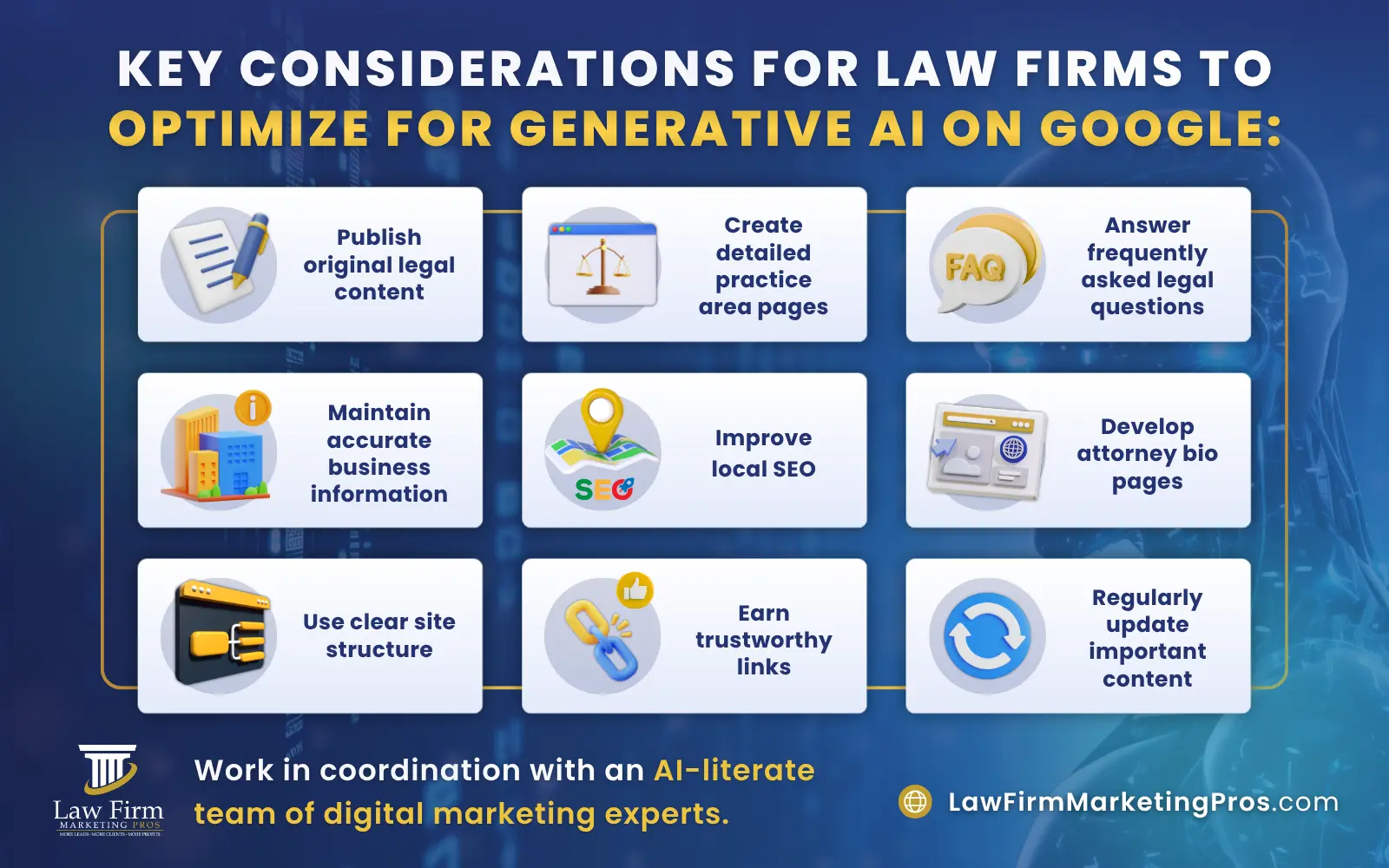
How Can a Law Firm Optimize for Generative AI on Google?
A law firm can optimize for generative AI on Google by focusing on the same principles that support strong SEO while creating more complete and useful information for users.
Important steps include:
- publishing original legal content
- creating detailed practice area pages
- answering frequently asked legal questions
- maintaining accurate business information
- improving local SEO
- developing attorney bio pages
- using clear site structure
- earning trustworthy links
- regularly updating important content
The goal is not to create content specifically for AI systems. The goal is to create valuable information that AI systems can understand and users can trust.
What are Google AI Overviews and How Do They Affect Law Firms?
Google AI Overviews provide AI-generated summaries within Google search results for certain queries.
For law firms, this means potential clients may receive initial information through Google before clicking traditional search listings. This creates both opportunities and challenges.
A law firm that publishes accurate, comprehensive resources may have a greater opportunity to be referenced in AI-generated responses. However, firms that try to rely on thin content or generic explanations may have difficulty standing out.
The focus should remain on creating authoritative resources that answer real client questions.
Does AI-Generated Content Hurt a Law Firm’s SEO?
AI-generated content does not automatically hurt SEO. The issue is whether the content provides genuine value.
Google evaluates content based on quality, usefulness, accuracy, and whether it satisfies users.
Problems arise when law firms use AI tools to:
- publish large amounts of generic content
- create inaccurate legal explanations
- avoid attorney review
- replace experience with automation
AI can be a helpful tool when used responsibly. However, legal content requires careful oversight because laws, regulations, and procedures change.
What is the Difference Between SEO, Answer Engine Optimization, and Generative Engine Optimization?
Search Engine Optimization (SEO) focuses on improving visibility in search engines by creating technically sound websites and valuable content. Answer Engine Optimization (AEO) focuses on creating content that clearly responds to specific questions. Generative Engine Optimization (GEO) focuses on improving how content may be interpreted and referenced by generative AI systems.
For law firms, these strategies overlap.
The strongest approach is not choosing one over another. It is creating a complete digital marketing strategy that combines technical SEO, authoritative legal content, local visibility, and user-focused answers.
How important is people-first legal content for AI search?
People-first legal content is increasingly important because AI systems need reliable information to provide useful responses. For attorneys, this means creating content that goes beyond basic definitions.
Strong legal content should explain:
- what a legal issue means
- what steps someone may consider
- what factors affect a situation
- what questions commonly arise
- why legal guidance may vary depending on circumstances
Content created from actual legal experience is typically more valuable to both searchers, search engines, and the answer engines addressing searchers’ queries than content designed only around keywords.
Should law firms create more blogs to improve AI visibility?
Publishing a larger quantity of content is not always the answer. A law firm may benefit more from improving the quality of existing resources than producing large amounts of additional content.
A strategic content plan should focus on:
- important practice areas
- client questions
- local search opportunities
- gaps in existing information
- improving outdated resources
A smaller number of comprehensive, authoritative pages can often provide more value than many short articles with limited depth.
How Do Google Business Profile Optimization and Local SEO Affect AI Search?
Local SEO remains important because many legal searches involve geographic intent.
Potential clients frequently search for attorneys based on:
- location
- practice area
- availability
- reputation
Google Business Profile optimization helps provide accurate information about a law firm’s location, services, reviews, and contact information.
Local SEO signals continue to help Google understand which legal services are relevant for specific searches.
What AI Risks Should Attorneys Consider When Using AI Marketing Tools?
Attorneys should be aware that AI tools can create inaccurate or outdated information.
Potential risks include:
- incorrect legal citations
- outdated regulations
- misleading statements
- inaccurate jurisdictional information
- wrong or careless use of client or employee information
- content that does not comply with attorney advertising rules
Law firms should only use AI as a supporting tool, rather than replacing professional review and careful decision-making. Marketing decisions involving legal content should include appropriate oversight from attorneys and experienced legal marketing professionals.
Why should law firms work with AI-literate marketing professionals?
AI is changing digital marketing quickly, but successful law firm marketing still requires strategy, experience, and judgment.
An AI-literate marketing team helps attorneys understand:
- which AI changes matter
- which industry claims are unsupported
- how SEO fundamentals continue to evolve
- how to create content that builds trust
- how to adapt marketing campaigns responsibly
The value is not simply knowing how to use AI tools. The value is knowing when and how to apply them effectively.
The Future of Legal Marketing Requires Strategy, Not Just Technology
Generative AI is changing how people search for information, but the foundation of successful legal marketing remains consistent.
Law firms that succeed in this environment will focus on:
- accurate information
- strong SEO foundations
- authoritative legal resources
- technical website performance
- local visibility
- meaningful client-focused content
The firms that struggle will often be those that treat AI as a shortcut.
Publishing more AI-generated pages, chasing every new AI marketing term, or relying on automated tools without review does not create long-term visibility. In many cases, it can harm a firm more than it may help. The future belongs to law firms that combine technology with human expertise and oversight.
AI tools can help legal marketing teams work more efficiently, but strategy remains essential. Success in legal marketing requires understanding search behavior, legal audiences, ethical considerations, legal knowledge, professional experience, and human insights.
Trust the Experts at Law Firm Marketing Pros with Your Marketing Efforts
For law firms preparing for the next generation of Google search, the goal is not simply to appear in AI responses. The goal is to become the type of trusted resource that users, search engines, and AI systems recognize as valuable. Law Firm Marketing Pros helps attorneys and law firms adapt to these changes through AI-aware digital marketing strategies built around SEO, content development, website optimization, and long-term visibility.
Join the elite law firms who trust Law Firm Marketing Pros and our proprietary Law Firm Client Generation System™. We’ll promote your law firm’s brand, create a hyper-optimized law firm website, and handle everything from web design to content marketing and law firm SEO incorporating AEO/GEO to the creation of a legal marketing funnel that drives qualified leads.
At Law Firm Marketing Pros, we partner with aggressive growth-minded attorneys seeking more cases by getting their digital marketing right. Result: Make more money, reclaim valuable time, and focus on what matters most.
Contact Partner and Co-Founder Josh Konigsberg, author of Law Firm Digital Marketing Made Easy: The Only Book You’ll Ever Need to Become a Best-Known Attorney, to schedule a free 15-minute client accelerator call at (561) 948-5001 or complete our online form.
Though brief, this call dives deep into your strategy. Josh will then prepare a complimentary digital marketing brief packed with 25-35 pages of value that drives qualified clients directly to your practice.
Copyright © 2026. Law Firm Marketing Pros. All rights reserved.
This blog is not intended to be legal advice for a lawyer or law practice. No special relationship or privilege exists between you and the Blog and/or its owners, Law Firm Marketing Pros, or its Affiliates (“LFMP”). LFMP IS NOT A LAW FIRM, and THE AUTHOR IS NOT AN ATTORNEY. You will be representing yourself and your law practice in any legal matter you undertake or any Client you represent as a result of your use of the information provided in the Blog, including any Services offered through the Blog and content available on the Site the Blog is published on and in all other matters relating to you and your businesses. This Blog may provide audio-video content, referenced articles, newsletters, and other content for informational purposes only. In the process of providing this information, the Blog is engaged in the publication of information regarding business and management issues that may be commonly encountered by law firms. This blog is not a substitute for the advice of an attorney. This Blog does not review any of your answers to questions for sufficiency, provide legal advice, or analyze applicable law and apply it to your specific requirements. Accordingly, if you need legal advice for a specific issue, you are advised to seek the advice of your local, state, and/or national Bar Association.
Law Firm Marketing Pros
250 S. Central Blvd, Suite 100-A
Jupiter, FL 33458
561-948-5001
https://lawfirmmarketingpros.com/