
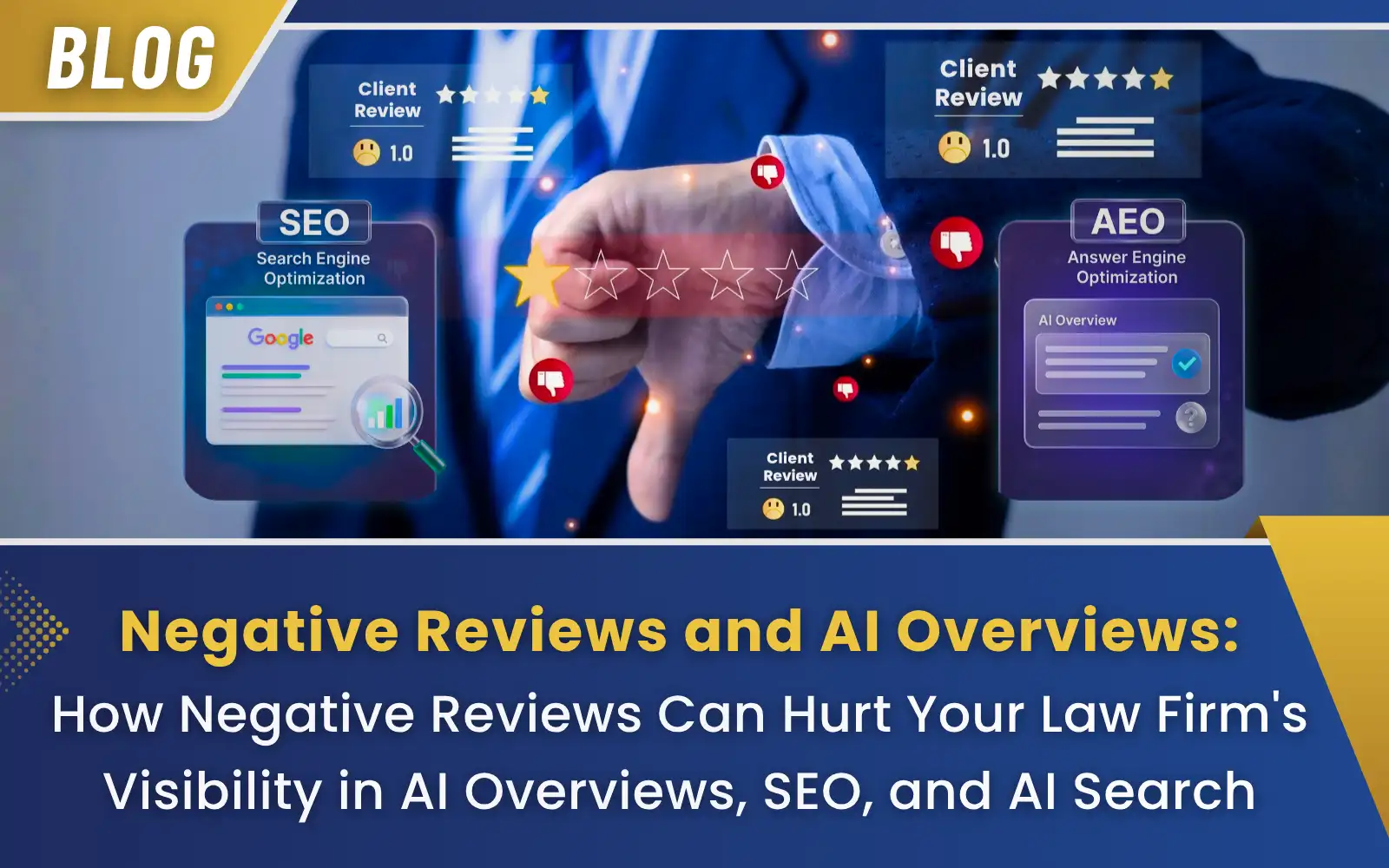
For years, law firms have treated online reviews primarily as a reputation and conversion issue. A prospective client sees a four-star or five-star rating, reads several reviews, and decides whether to contact the firm. That is still important. But the way people discover and evaluate law firms is changing. Below, we highlight the strong correlation among negative reviews and AI Overviews leading to reduced visibility — and what to do to protect your law firm’s online reputation and AI visibility.
Google and other AI-driven search systems can now synthesize information from a firm’s website, Google Business Profile, review platforms, directories, forums, social media, and other third-party sources. In some searches, users may see an AI-generated answer before they ever visit a law firm’s website.
More attorneys and law firm owners should be asking how negative reviews affect AI Overviews. It is no longer simply a theoretical SEO question. It is becoming a reputation, visibility, and client-acquisition question. A single old negative review, duplicated across several review sites, can repeatedly appear in AI-generated answers about a company. Sometimes negative reviews might be republished across multiple domains.
For law firms, the implications may be even more significant because prospective clients are often making highly personal, high-stakes decisions based on limited information. Read below to learn how negative reviews affect AI Overviews, SEO, and AI search for law firms, and how reputation management and AI Overview optimization can help protect online visibility.
Key Takeaways
A law firm’s reputation increasingly exists across the entire web, not just on its own website. AI systems may draw from third-party information when generating an answer about a firm.
- Negative reviews can become part of the information environment that AI search systems evaluate and summarize.
- A few bad reviews do not automatically mean that a law firm will be negatively represented in AI Overviews.
- Repeated claims across multiple review platforms can potentially appear more significant to AI systems than the firm realizes.
- Google AI has demonstrated the ability to surface individual reviews in AI Overviews for review-related searches.
- Reputation management is therefore becoming connected to SEO, local search, and AI search visibility.
- Removing a legitimate negative review is not always possible or appropriate. Google says reviews should not be reported simply because a business dislikes or disagrees with them.
- Law firms should monitor what AI systems actually say about their brand rather than assuming their website tells the complete story.
- Proactive review generation, accurate public information, authoritative content, and third-party reputation management can create a stronger information environment around a firm.
- AI Overview optimization should complement, rather than replace, traditional SEO, local SEO, content, and reputation strategies.
- Ethical review practices matter. Law firms should never manufacture, purchase, manipulate, or selectively distort reviews.
Why a Single Negative Review Can Become a Bigger Problem in AI Search
A negative review has traditionally been visible to people who went looking for it.
A potential client might search for a law firm, open its Google Business Profile, read the reviews, notice one unfavorable comment, and decide whether the criticism seems credible.
AI search changes that sequence.
Instead of requiring the user to read dozens of reviews, an AI system can summarize what it finds and provide an answer to the user’s query. That means a user does not necessarily have to search for “negative reviews” before encountering negative information.
Research and industry testing in 2026 have documented examples of AI-generated answers incorporating negative review information even when the original user query was broader than a review search. Search Engine Journal reported Q1 2026 data involving AI Overviews surfacing negative reviews in response to queries where the user was not specifically looking for reviews.
This matters for attorneys because a prospective client might ask:
- “Is this a good personal injury law firm?”
- “What is this law firm known for?”
- “Which lawyers handle medical malpractice in Chicago?”
- “What should I know before hiring this attorney?”
- “Compare these three law firms.”
The user’s query may have nothing to do with reviews.
Yet reputation information can become part of the answer.
How AI Systems Can Amplify a Reputation Signal
One of the most important lessons from the report is that repetition across websites can change how information appears to an AI system. In the report’s example, an old negative review had been duplicated across multiple review sites. The same underlying allegation appeared repeatedly, and AI-generated answers treated the repeated presence as meaningful evidence. The company ultimately identified the source and published verifiable information addressing the issue.
This does not mean AI systems intentionally treat every duplicate review as independent confirmation. It means marketers should not assume that one old review is insignificant simply because few people are reading the original page.
For example, imagine a law firm receives one negative review alleging poor communication.
That review later appears on several third-party sites.
An AI system encounters the same allegation while researching the firm.
The system may then encounter:
- the firm’s website
- its Google Business Profile
- attorney directories
- legal directories
- social media
- news coverage
- review platforms
- forum discussions
- other web pages
If the negative allegation is one of the clearest pieces of third-party information available, it may receive disproportionate attention in certain responses.
That is the potential compounding effect.

Why Law Firms Face a Unique Reputation Challenge
Law firms are not ordinary businesses.
Clients may be deciding whether to trust an attorney with a personal injury claim, criminal charge, divorce, immigration matter, estate, business dispute, intellectual property issue, or another highly sensitive legal problem.
A prospective client may have no practical way to evaluate legal quality before hiring an attorney.
As a result, the client often looks for indirect signals:
- What do other clients say?
- Does the attorney communicate well?
- Does the firm appear established?
- Is the website credible?
- Are there consistent reviews?
- Does the attorney appear frequently in search?
- Does the firm have relevant experience?
- What does the broader web say?
AI search can bring many of those signals together.
That means the firm’s reputation is increasingly an entity-level issue. The website is one source of information about the firm. It is not necessarily the only source an AI system will consider.
Negative Reviews Can Affect More Than Reputation
It would be inaccurate to say that one negative review automatically causes a ranking penalty.
Google does not publish a rule saying that a negative review directly causes a website to lose organic rankings.
Instead, the concern is broader.
Negative Google reviews and other negative reviews may affect each of the following:
- how potential clients perceive a firm
- how users interact with its business profile
- whether people click through to the website
- whether prospects contact the firm
- what third-party information is available for AI systems to summarize
That makes reputation part of a broader SEO strategy.
A law firm can have excellent content and technically-sound SEO while still having an information problem elsewhere on the web.
This is one reason reputation management should not be viewed as a completely separate service from search marketing.
Google AI, Reviews, and the Expanding AI Search Ecosystem
Google has increasingly incorporated review information into AI-generated search experiences.
In 2025, search industry observers documented Google AI Overviews displaying individual Google Business Profile reviews for certain review-related searches.
Google has also experimented with connections between review interfaces and AI-generated search experiences, and broader research analyzing more than 804,000 AI responses across 1,926 brands and found that having profiles on third-party review sites correlated with higher AI citation rates.
The practical lesson is not that every review will appear in every AI answer. The lesson is that reviews are becoming part of the information ecosystem surrounding a business or law firm. That makes ignoring them increasingly risky.
Why More Reviews Are Not Necessarily the Complete Answer
A common reaction to a negative review is to say, “We just need more five-star reviews.”
More authentic reviews can certainly strengthen a firm’s reputation profile. However, quantity alone is not a complete AI search strategy.
Suppose a firm has 100 positive reviews and one detailed negative review.
The negative review might still contain a distinctive claim that AI systems can easily summarize.
The solution is not to manufacture positive feedback or attempt to suppress legitimate criticism.
Instead, the firm should build a broader, accurate, publicly verifiable body of information about the firm.
That can include:
- authentic client reviews
- detailed attorney biographies
- practice-area pages
- educational resources
- case-related information that can ethically and legally be disclosed
- awards and professional recognition where appropriate
- community involvement
- authoritative legal content
- media coverage
- accurate directory profiles
- consistent business information
- credible third-party references
The goal is to create a stronger and more complete public record.
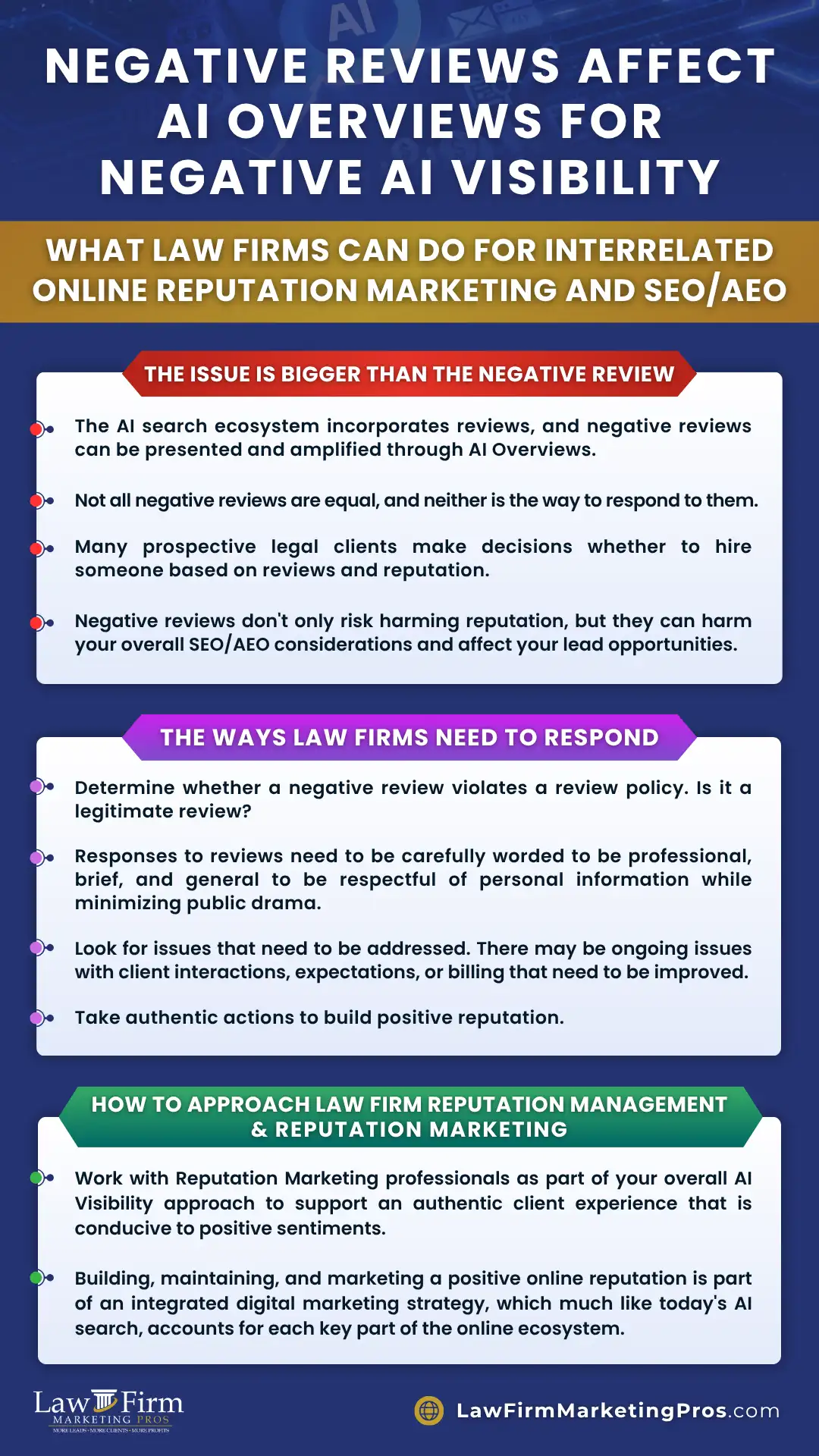
What Law Firms Should Do When a Negative Review Appears
The first step is to determine what kind of problem you actually have.
Not every negative review should be removed.
Google states that negative Google reviews are not eligible for removal merely because a business disagrees with them. Reviews can be reported when they violate applicable policies, but legitimate criticism does not automatically qualify.
1. Determine Whether the Review Violates a Platform Policy
Look for issues such as:
- fake engagement
- spam
- conflicts of interest
- impersonation
- prohibited content
- reviews from people who did not have the claimed experience
- coordinated manipulation
- other policy violations
If a review appears to violate policy, document the issue and submit the appropriate report.
2. Respond Carefully
Law firms face an additional problem: confidentiality.
An attorney generally cannot respond to a public criticism by revealing confidential information simply to defend the firm.
A response may therefore need to be brief, professional, and appropriately general.
Do not turn a public review into a public argument.
3. Look for the Underlying Issue
Sometimes negative feedback identifies a genuine problem.
Communication delays, intake problems, unclear expectations, billing confusion, or poor follow-up can create recurring complaints.
Review monitoring can reveal patterns that internal reports may not show.
4. Build More Authentic Positive Evidence
Law firms should make it easy for actual clients to provide honest feedback without telling them what sentiment to express.
Google permits businesses to ask customers for reviews but prohibits incentives and other practices that manipulate the review process.
Reputation Management Has Become Part of AI Visibility Management
Traditional reputation management often focused on monitoring reviews, responding to complaints, and attempting to suppress or remove harmful information.
That remains useful, but AI search requires a broader approach.
Modern law firm reputation management should also ask:
What does AI search say about our firm?
A useful monitoring program should periodically test branded queries such as:
- “What is [Law Firm Name] known for?”
- “What is [Law Firm Name]’s reputation?”
- “Should I hire [Attorney Name]?”
- “What are the strengths and weaknesses of [Law Firm Name]?”
- “How does [Law Firm Name] compare with other firms?”
- “What do clients say about [Law Firm Name]?”
Then track the responses.
This can reveal information that traditional ranking reports do not.
A firm may rank well for its primary keywords while an AI answer creates a different perception of the brand.
That is why AI search monitoring should increasingly sit alongside traditional SEO reporting.
AI Overview Optimization Is Not About Hiding Negative Information
AI Overview optimization should never mean attempting to manipulate an AI system into saying something untrue. The objective is to make accurate, useful, authoritative information easier for search systems and users to discover. The distinction matters for reasons that can affect the whole ecosystem.
A strong AI Overview optimization strategy can include:
- clear factual content
- well-organized pages
- authoritative legal information
- relevant internal links
- accurate business information
- structured data where appropriate
- consistent third-party profiles
- strong local SEO
- authentic reviews
- reputable external mentions
- content that directly answers common questions
The objective is to create an information environment in which accurate information about the firm is abundant, accessible, relevant, and supported by credible sources.
The Legal Ethics Issue: Reputation Management Cannot Become Review Manipulation
Law firms need to be especially careful not to engage in review manipulation.
The Federal Trade Commission’s Consumer Reviews and Testimonials Rule addresses various deceptive practices involving consumer reviews, including fake or false reviews, purchasing reviews, conditioning incentives on particular positive or negative sentiment, and certain forms of review suppression.
Google likewise prohibits fake engagement and incentivized reviews and says reviews should reflect genuine experiences.
Attorneys also operate under professional-conduct rules governing communications about legal services. ABA Model Rule 7.1, for example, states that lawyers may not make false or misleading communications about themselves or their services, although individual state rules govern the attorney’s actual obligations.
For that reason, a reputable marketing strategy should never involve:
- creating fake reviews
- paying people to post favorable reviews
- posting AI-written reviews that are not given from clients
- asking only satisfied clients for reviews in a way that manipulates the review process (review gating)
- threatening legitimate reviewers
- concealing material information
- or publishing misleading claims to counter criticism
The objective should be to improve the firm’s real reputation and public information footprint, not manufacture one.
Why a One-Time Blog Post May Not Fix the Problem
The example from SEO Roundtable provides another important lesson. When the problem exists primarily on third-party websites, publishing one article on the company’s own website may not be enough.
The task can involve identifying the external sources responsible for the recurring claim, publishing defensible data, and creating information that AI systems could use as a credible source. The company later reported that the negative claim stopped appearing in the tested responses, although its subsequent testing also demonstrated that AI visibility can change over time.
For law firms, this means reputation work may require several coordinated activities:
- Audit the existing reputation landscape.
- Identify which sources AI systems appear to rely upon.
- Determine whether problematic information is accurate, outdated, duplicated, misleading, or policy-violating.
- Address removable violations through the appropriate channels.
- Respond appropriately where a response is warranted.
- Publish accurate first-party information.
- Develop authentic review activity.
- Strengthen authoritative third-party signals.
- Monitor AI search responses.
- Repeat the process as the information environment changes.
That is much more durable than simply writing another blog post.

Where LFMP’s Top Rated Law Firm Can Guide the Solution
Law Firm Marketing Pros‘ online reputation marketing service, Top Rated Law Firm (TRLF), is designed around engaged reputation monitoring and marketing rather than treating reviews as an occasional crisis.
TRLF can monitor positive and negative reviews, help materialize new authentic customer reviews, share reviews through social channels, filter qualified leads attracted by a firm’s positive/improved reputation, and provide feedback and data that can inform subsequent marketing decisions.
That approach makes sense in the AI search environment because the objective is not simply to react after a negative review becomes a problem; it is to continuously build and monitor the firm’s broader reputation.
TRLF is one component of a larger marketing system addressing the AI search ecosystem, not a magic solution for AI visibility.
A strong program for attorneys and law firms can combine reputation monitoring with:
- Law Firm SEO (Organic SEO)
- Local SEO
- Website Design for Law Firms
- Website Hosting, Monitoring, & Maintenance
- Google Business Profile Optimization
- Blog & Content Marketing
- Video Content
- Comprehensive Practice Area Pages
- Digital PR
- Pay-Per-Click for Lawyers
- Social Media
- Conversion-Assisted CRM
- Reporting and Analytics
- Digital Lead Funnels for Lawyers
- AI Visibility
Law Firm Marketing Pros handles reputation monitoring and marketing, law firm SEO, websites, social media, PPC, reporting and analytics services, and more for law firms.
Why AI-Literate Legal Marketing Professionals Matter
The biggest challenge regarding AI for attorneys is not necessarily learning every new AI tool.
It is knowing which changes matter.
A law firm owner already has clients, cases, employees, court deadlines, compliance responsibilities, and business decisions to manage.
Meanwhile, the search environment continues to evolve.
Google AI, AI Overviews, ChatGPT, Perplexity, Gemini, traditional search, local search, review platforms, directories, social media, and other systems can all contribute to how a firm’s online presence is discovered and interpreted.
That creates an unusually complex marketing environment.
An AI-literate legal marketing team can monitor these systems, identify emerging problems, compare them against traditional SEO data, and determine whether the appropriate response is content, technical SEO, local SEO, reputation management, PR, review monitoring, or some coordinated combination.
Law Firm Marketing Pros uses an approach that combines SEO, reputation management, AI-driven strategies, GEO, AEO, and other digital marketing services specifically for law firms.
The advantage of working with a team dedicated to legal marketing is that these activities do not have to exist in separate silos.
The Law Firm Reputation Strategy for Fall 2026 and Beyond
The most resilient law firms will not treat SEO, reviews, reputation, content, and AI search as unrelated marketing activities because each of these components are interconnected in today’s search ecosystem.
For example:
- A prospective client might first discover a firm through Google.
- Then the client may see the firm’s Business Profile.
- Next, the client may read reviews.
- Then the client may ask an AI system about the firm.
- The AI answer may draw on the firm’s website and third-party sources.
The client may then return to Google, search the attorney’s name, look at another review platform, visit LinkedIn, read an article, and finally call the firm.
There is no single page controlling that journey. The firm’s entire digital presence becomes part of the decision-making process.
That is why the future of law firm reputation management is not simply about trying to make negative reviews disappear.
It is about building a credible, accurate, active, and well-supported digital presence that gives both users and AI systems better information to discover.

Frequently Asked Questions About Negative Reviews and AI Overviews
These questions address common informational and long-tail searches surrounding reviews, AI search, and law firm visibility.
Can negative reviews hurt a law firm’s SEO?
Negative reviews do not automatically create an organic ranking penalty. However, they can affect reputation, user perception, local visibility, click behavior, conversions, and the information available to AI search systems. Those indirect effects make reviews relevant to an overall SEO strategy.
Do Google reviews appear in AI Overviews?
They can. Search industry testing has documented Google AI Overviews displaying individual Google Business Profile reviews for certain searches. The exact information shown can vary by query, location, time, and Google’s systems.
Can AI Overviews show negative reviews when someone is not searching for reviews?
Yes, this has been observed in current research and testing. AI systems can surface reputation-related information while answering broader questions about a company or brand. That is one reason monitoring branded AI queries is becoming important.
Can a few bad reviews cause an AI system to say negative things about a law firm?
A few bad reviews do not automatically produce a negative AI answer. However, distinctive claims, repeated information, third-party coverage, and the overall availability of positive and negative evidence can influence what information an AI system encounters and chooses to summarize.
Should a law firm try to remove every negative Google review?
No. A negative review is not automatically removable simply because a firm dislikes it. Google says reviews should be reported when they violate applicable policies, rather than simply because a business disagrees with them.
How can a law firm respond to a negative review?
A firm should respond professionally and avoid revealing confidential client information. The response should acknowledge the feedback where appropriate without turning the review into a public dispute. Firms should also investigate whether the feedback identifies a genuine operational problem.
Can law firms pay clients to leave positive reviews?
Law firms should not assume that paying for or incentivizing positive reviews is acceptable. Google prohibits incentivized reviews, and the FTC’s rule addresses compensation or incentives conditioned on a particular review sentiment. State-specific attorney advertising and ethics rules may impose additional requirements.
What is AI Overview optimization for a law firm?
AI Overview optimization is the process of improving the firm’s online information ecosystem so that accurate, relevant, authoritative information is easier for AI-driven search systems to discover, interpret, and potentially cite. It works alongside traditional SEO rather than replacing it.
What should a law firm do if AI search gives a false answer about the firm?
First, document the response, query, date, and cited sources. Then identify where the inaccurate information originated. Depending on the problem, the appropriate response might involve correcting a website page, addressing a third-party listing, reporting a policy violation, strengthening authoritative public information, or monitoring the AI response over time.
Protect Your Law Firm’s Visibility in the AI Search Era
The biggest mistake a law firm can make is assuming that its website tells the complete story about its online reputation.
It does not.
The public web contains reviews, directory listings, articles, social media discussions, videos, forums, professional profiles, news coverage, and countless other signals. AI systems can use some of those sources when constructing answers.
That makes reputation a broader digital asset.
The answer is not to panic over every negative review. It is not to chase every AI response. And it is certainly not to manufacture positive sentiment.
Instead, law firms should build an ongoing strategy around accurate information, authentic reviews, authoritative content, technical SEO, local visibility, reputation monitoring, and AI search visibility.
A committed team of AI-literate legal marketing professionals can help identify where a firm’s information is coming from, what users and AI systems are seeing, which issues actually require attention, and where marketing resources are most likely to have an impact.
For aggressive-growth-minded attorneys and law firms, that distinction matters.
The goal is not merely to rank… The goal is to build a digital presence that remains credible when a prospective client, a search engine, or an AI system asks about your firm.
If you are concerned about what AI search says about your law firm, Law Firm Marketing Pros can evaluate your existing search, reputation, SEO, and AI visibility and help identify practical opportunities for improvement. Reputation monitoring and marketing, including the Top Rated Law Firm service, can become part of a broader strategy designed specifically around the way prospective clients discover and evaluate attorneys today.
Contact Law Firm Marketing Pros to discuss your firm’s digital reputation, SEO, and AI search visibility and determine what should be monitored, improved, or addressed next.
Join the elite law firms who trust Law Firm Marketing Pros and our proprietary Law Firm Client Generation System™. We’ll promote your law firm’s brand, create a hyper-optimized law firm website, and handle everything from web design to content marketing and law firm SEO incorporating AEO/GEO to the creation of a legal marketing funnel that drives qualified leads.
At Law Firm Marketing Pros, we partner with aggressive growth-minded attorneys seeking more cases by getting their digital marketing right. Result: Make more money, reclaim valuable time, and focus on what matters most.
Contact Partner and Co-Founder Josh Konigsberg, author of Law Firm Digital Marketing Made Easy: The Only Book You’ll Ever Need to Become a Best-Known Attorney, to schedule a free 15-minute client accelerator call at (561) 948-5001 or complete our online form.
Though brief, this call dives deep into your strategy. Josh will then prepare a complimentary digital marketing brief packed with 25-35 pages of value that drives qualified clients directly to your practice.
Copyright © 2026. Law Firm Marketing Pros. All rights reserved.
This blog is not intended to be legal advice for a lawyer or law practice. No special relationship or privilege exists between you and the Blog and/or its owners, Law Firm Marketing Pros, or its Affiliates (“LFMP”). LFMP IS NOT A LAW FIRM, and THE AUTHOR IS NOT AN ATTORNEY. You will be representing yourself and your law practice in any legal matter you undertake or any Client you represent as a result of your use of the information provided in the Blog, including any Services offered through the Blog and content available on the Site the Blog is published on and in all other matters relating to you and your businesses. This Blog may provide audio-video content, referenced articles, newsletters, and other content for informational purposes only. In the process of providing this information, the Blog is engaged in the publication of information regarding business and management issues that may be commonly encountered by law firms. This blog is not a substitute for the advice of an attorney. This Blog does not review any of your answers to questions for sufficiency, provide legal advice, or analyze applicable law and apply it to your specific requirements. Accordingly, if you need legal advice for a specific issue, you are advised to seek the advice of your local, state, and/or national Bar Association.
Law Firm Marketing Pros
250 S. Central Blvd, Suite 100-A
Jupiter, FL 33458
(561) 948-5001
https://lawfirmmarketingpros.com/