

Why Law Firms Should Prepare for 2027 Before Q1
A strong start to the new year begins before January. For ambitious law firms, the final months of 2026 are an opportunity to evaluate marketing performance, identify growth opportunities, and address weaknesses before another year of spending and competition begins. A well-developed law firm marketing plan for 2027 should connect business objectives with the digital marketing activities, staffing, technology, and measurement needed to pursue them.
The stakes are particularly high in legal services. Prospective clients may compare several attorneys before making contact, and the path from an initial search to a signed engagement can involve multiple interactions. Sometimes current strategies may be blind, incomplete, or misguided: A firm can generate website traffic without attracting the right clients, invest in paid advertising without understanding which inquiries become cases, or publish content without building meaningful visibility for its practice areas.
Search behavior is changing. Traditional search results now coexist with AI-generated summaries and other AI-assisted discovery experiences. Law Firm Marketing Pros leverages a team of AI-literate law firm marketing professionals to help law firms throughout the United States understand these developments without abandoning established marketing fundamentals or accepting unsupported assumptions or promises about rankings and AI citations.
The objective of making these 5 marketing moves early is to make more informed decisions about where to invest, what to improve, and how to evaluate progress. Build a law firm marketing plan for 2027 with five practical moves covering budget, SEO, paid advertising, lead conversion, and AI-informed marketing strategy.
Reach out for a Free 15-minute Client Accelerator Call if you are ready to ask the right questions and take the right steps to help your firm grow in 2027.
Key Takeaways
- Review 2026 marketing performance before setting new goals or increasing spending.
- Build a law firm marketing budget around business objectives, practice areas, target markets, and available intake capacity.
- Strengthen the website, Search Engine Optimization (SEO), local SEO, and useful legal content to improve discoverability and conversion.
- Evaluate paid advertising alongside lead quality, intake follow-up, and the firm’s ability to turn inquiries into clients.
- Establish clear key performance indicators, reporting responsibilities, and a practical Q1 implementation schedule.
- Use AI-informed tools and analysis with experienced human oversight, particularly where legal accuracy, professional responsibility, and brand reputation are involved.
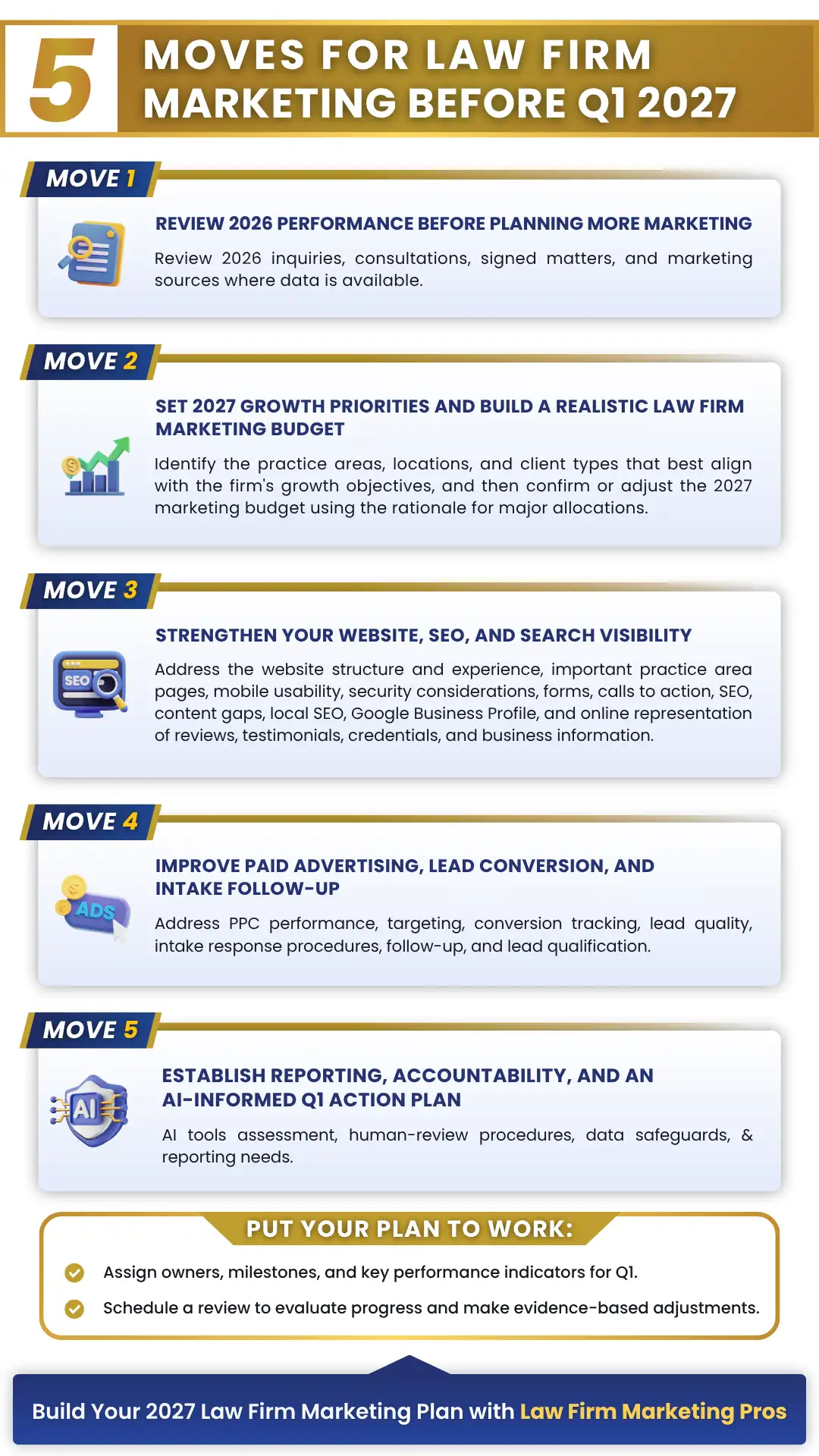
Move 1: Review 2026 Performance Before Planning More Marketing
The first step in a good marketing plan is understanding what happened during the previous year. Before adding campaigns, increasing ad spend, or adopting new technology, law firms should assess which marketing activities contributed to meaningful business opportunities and which need improvement.
Evaluate Leads, Cases, and Marketing Performance Together
Start by examining the relationship between marketing activity and the firm’s business goals. Website traffic, search rankings, advertising impressions, and social engagement can help explain visibility, but these measures do not tell the whole story. The firm also needs to understand what happened after prospective clients made contact.
Review inquiries by source, practice area, location, and disposition where reliable data is available. Consider how many inquiries were qualified, how many consultations were scheduled, how many prospective clients retained the firm, and what the firm learned from cases or legal matters it did not accept. For contingency-fee practices, signed matters and eventual case economics may be important, although those outcomes can take substantial time to mature. Other practice areas may prioritize consultation volume, recurring engagements, or different measures of business value.
Use Google Analytics and other reporting systems to understand website traffic, landing-page behavior, and conversion events. Compare these findings with call tracking, CRM records, and intake data. Google Analytics alone generally cannot tell a firm whether an inquiry became a signed client unless the relevant systems and data are appropriately connected.
The goal is to build a credible baseline, not to claim perfect attribution where it does not exist.
Identify What to Retain, Improve, or Discontinue
A useful annual review separates marketing activities into three groups: those worth continuing, those that require changes, and those that no longer justify their cost or effort. Relevance of inquiries is an important factor. A campaign with relatively high lead volume may still underperform if inquiries are irrelevant, while a smaller campaign may contribute valuable new business.
Examine referral sources, client reviews, organic search performance, paid ad campaigns, and the conversion performance of important practice area pages. Check whether leads are being handled promptly and whether marketing reports reflect the firm’s actual intake process.
This review should also consider the firm’s capacity. Marketing that generates more inquiries than the office can handle may create unnecessary costs and poor prospective-client experiences. Conversely, a firm with room to grow may need to increase visibility in a particular practice area or market.
Before moving on: Document the baseline, the strongest opportunities, the main operational constraints, and the data gaps that need attention in Q1.

Move 2: Set 2027 Growth Priorities and Build a Realistic Law Firm Marketing Budget
A law firm marketing strategy should begin with the type of growth the firm wants to achieve, not with a list of services or a predetermined spending percentage. The right plan for a growing personal injury firm may differ significantly from the plan for an estate planning practice, a business law firm, or a firm expanding into a new geographic market.
Define the Right Clients, Practice Areas, and Markets
Clarify which legal services the firm wants to grow and which types of matters best align with its capabilities, economics, and long-term objectives. Identify the locations the firm serves, the clients it wants to reach, and the reasons prospective clients might choose it over competing firms.
Client personas (aka “avatars”) can help organize these insights. For example, a family law firm may need to communicate differently with someone researching an initial consultation than with someone ready to discuss representation. A personal injury firm may need a clear, accessible path for people seeking legal help after an accident. These distinctions can influence content, landing pages, calls to action, and intake procedures.
A competitive analysis can reveal how other firms position their services, what information they provide, and where the market appears underserved. It should inform decisions rather than encourage imitation.
Allocate Resources According to Priorities
The law firm marketing budget should account for existing commitments, growth objectives, competition, the firm’s geographic footprint, and the capacity to manage additional inquiries. Consider the roles of SEO, PPC, website improvements, proactive website monitoring and maintenance, content marketing, reputation marketing, video, social media marketing, and intake technology.
Do not assume every firm needs to invest equally in every channel. A firm with weak website conversion may benefit more from improving its digital foundation than from sending additional traffic to an ineffective landing page. A firm with strong organic visibility but insufficient qualified inquiries in a priority practice area may need a different combination of content, paid advertising, and conversion improvements.
Budget for implementation and ongoing management, not merely the initial launch. SEO, website maintenance, reporting, content review, campaign optimization, and intake improvements all require continued attention.
A structured plan should specify the priority, expected work, responsible party, budget, timeline, and method of evaluation for each major initiative.
Make the Plan Flexible Enough to Improve
A marketing plan should establish direction without becoming an inflexible annual commitment. Review performance regularly and make changes when the evidence supports them. Preserve sufficient flexibility to respond to changes in competition, business capacity, market demand, and search behavior.
The objective is to spend money deliberately, maintain consistency, and make decisions based on what the firm learns rather than on assumptions about which channel must work best.
Move 3: Strengthen Your Website, SEO, and Search Visibility
A law firm’s digital presence influences whether prospective clients discover the firm, understand its legal services, and decide to make contact. A website that looks professional but contains thin service information, confusing navigation, or weak calls to action may fail to support the firm’s growth objectives.
Improve the Website Around Prospective-Client Needs
Review the firm’s website from the perspective of someone looking for legal help. Can visitors quickly identify the relevant practice area, understand whom the firm serves, learn what the next step involves, and find accurate contact information?
Evaluate page speed, mobile usability, accessibility, navigation, security considerations, forms, calls to action, and the consistency of the firm’s messaging. Check whether important practice area pages provide substantive, accurate information rather than generic text that could describe any competitor.
Each major page should serve a clear purpose. Practice area pages can explain the services offered, common concerns, relevant processes, and reasons a visitor might consider contacting the firm. Location pages should reflect genuine service-area relevance and provide useful local information rather than repeating city names across nearly identical pages.
Website improvements should also account for conversion. A well-designed law firm website needs to help appropriate visitors take the next step, whether that means calling the office, submitting an inquiry, or scheduling a consultation.
Hosting, monitoring, and maintenance considerations often require being proactive, leading with best practices, and responding in a timely manner to emerging security threats or trends. Be sure to assess whether your current hosting and website management are handling these responsibilities effectively.
Build an SEO Strategy Around Useful, Credible Content
Search Engine Optimization is not simply a matter of adding relevant keywords. A sustainable law firm marketing strategy combines technical accessibility, useful content, appropriate internal linking, a clear site structure, and credible information that serves the intended audience.
Review the firm’s organic search performance, relevant keywords, existing content, and gaps in its coverage of important practice areas. Update outdated pages and develop content that answers real questions prospective clients ask. A Blog should strategically contribute useful information for target clients in a way that clearly addresses questions they may be seeking answers to online or in the course of their research or experience with the relevant legal matter.
Local SEO deserves particular attention for firms that depend on geographically relevant inquiries. Review the firm’s Google Business Profile for accuracy, completeness, and consistency with its actual operations. Maintain accurate contact details, select appropriate categories, and follow applicable rules when requesting and responding to client reviews.
Positive reviews and client testimonials can contribute to trust, but they should be handled in accordance with platform policies and applicable attorney advertising requirements. Do not fabricate reviews, misrepresent client experiences, or imply that testimonials establish a guaranteed result.
AI Visibility: Prepare for AI-assisted Discovery Without Chasing Shortcuts
Search experiences are evolving, and AI systems may summarize information or help users compare legal service providers. Firms should respond and prepare by making their websites accurate, well organized, informative, and easy to understand.
Clarity and accuracy matter in many ways. Clear explanations, descriptive headings, consistent business information, credible authorship, and relevant supporting sources can help people and search systems interpret a page. The firm should also review whether its important services, locations, and professional credentials are represented accurately throughout its online presence.
However, no agency can responsibly promise that a particular page will appear in an AI Overview or be cited by a specific model. AI visibility depends on factors outside a firm’s direct control and can change over time.
The sensible objective is to improve the quality and discoverability of the firm’s digital information while monitoring how search behavior evolves. Useful content and sound technical practices remain worthwhile even when a particular AI feature changes.

Move 4: Improve Paid Advertising, Lead Conversion, and Intake Follow-Up
Paid advertising can help a law firm reach people searching for particular legal services, but campaign performance depends on more than clicks. Firms need to understand what they are paying for, whether the inquiries fit their practice, and what happens after a prospective client responds.
Evaluate Campaigns by Quality as Well as Volume
Review PPC campaigns by practice area, geography, search intent, landing page, and lead outcome. Examine search terms, irrelevant traffic, conversion tracking, and the alignment between ad messaging and the service offered.
Paid advertising should not be evaluated solely by the number of calls or form submissions it generates. Where reliable data exists, assess the proportion of inquiries that meet the firm’s criteria, consultations that take place, and matters that become engagements. Account for the time lag between advertising spend and eventual business outcomes.
Campaigns should also be reviewed for compliance with platform requirements and applicable attorney advertising rules. Avoid misleading claims, unsupported promises, or ad language that implies a guaranteed legal outcome.
Fix Intake Friction Before Increasing Ad Spend
A firm may be spending effectively to attract prospective clients but losing opportunities through missed calls, slow follow-up, confusing forms, or inconsistent intake procedures. Review how inquiries are handled during business hours and after hours, how staff record outcomes, and how the firm follows up with people who have requested contact.
Establish clear responsibilities and appropriate response procedures. Train staff to communicate professionally and respectfully, and make sure that the intake process protects confidential information and routes legal questions appropriately.
The right process depends on the firm’s practice areas and staffing. The aim is to help potential clients understand the next step while enabling the firm to assess inquiries efficiently.
Connect Marketing Reports to Business Decisions
Use reporting to identify where improvements are most likely to matter. If a campaign produces qualified inquiries but few consultations, investigate the intake process. If a landing page attracts relevant website traffic but few inquiries, assess the content, usability, and call to action. If a campaign produces irrelevant leads, examine its targeting, search terms, and messaging.
This is where coordinated marketing management can be especially valuable. SEO, PPC, website development, reputation, content, and intake should not operate as disconnected activities. Their combined performance matters more than isolated channel metrics.
Move 5: Establish Reporting, Accountability, and an AI-Informed Q1 Action Plan
A plan becomes useful when someone is responsible for carrying it out and the firm can determine whether the work is making a difference. Before January, establish a practical reporting and implementation process that keeps marketing activities connected to the firm’s business goals.
Define Meaningful Key Performance Indicators
Key performance indicators should reflect the firm’s priorities and the maturity of its measurement systems. Depending on the practice, these may include qualified inquiries, consultation rates, signed engagements, cost per qualified lead, organic visibility for priority services, conversion rates, and the percentage of leads with a known source.
Use Google Analytics for appropriate website and event measurements, and reconcile digital reporting with CRM and intake records wherever feasible. Document limitations, including missing call attribution, incomplete lead records, and delays in determining whether a matter becomes profitable.
Do not confuse a rise in website traffic with a rise in new clients. Instead, use several complementary measures to understand how marketing is contributing to the outcomes the firm wants.
Assign Ownership and Establish a Review Schedule
Identify who is responsible for each marketing task, what needs to be completed, and when the firm will review progress. The responsible parties may include internal marketing staff, attorneys, intake personnel, developers, and external partners.
A simple Q1 schedule can help translate the annual marketing plan into action:
- Before January: Complete the performance review, agree on priorities, confirm the budget, and identify urgent technical or intake problems.
- January: Launch approved improvements, establish reporting baselines, and verify that tracking works as intended.
- February: Review early evidence, identify implementation problems, and refine campaigns or content where justified.
- March: Assess progress against the original goals and agree on priorities for the next quarter.
This schedule should be adapted to the firm’s resources and the time needed for particular activities. SEO, for example, may take longer to demonstrate meaningful business impact than some paid campaign adjustments.
Use AI as a Managed Capability, Not a Substitute for Judgment
AI tools can assist with research, summarization, content planning, data analysis, reporting, and identifying potential opportunities. AI-literate professionals can help law firms evaluate where these tools are useful, where human review is necessary, and how to incorporate them into a reliable marketing workflow.
For example, an experienced marketing team may use AI-assisted analysis to organize search queries, identify patterns in campaign reports, or develop an initial content outline. Human reviewers should then verify claims, assess context, check sources, and confirm that the final work reflects the firm’s actual services and professional standards.
Legal marketing requires particular care. Generated content can contain inaccurate statements, unsupported legal claims, invented citations, or language that does not fit a firm’s voice. Sensitive client information also requires appropriate safeguards when using third-party tools. AI-assisted content should not be published without suitable review.
Firms should also resist the temptation to adopt a new AI tool simply because it is available. Assess the problem it is intended to solve, the quality of its output, its privacy implications, and the time required to supervise it. The best use of AI is to support knowledgeable professionals and sound processes, not to remove accountability.
For a firm managing several marketing channels, an AI-literate partner can help coordinate these decisions, translate data into priorities, and maintain a consistent strategy as search and technology evolve.
How LFMP’s Top Rated Law Firm Service Fits Into the Plan
For growth-minded law firms, a stronger marketing plan also requires a credible way to communicate what distinguishes the firm. LFMP‘s Top Rated Law Firm (TRLF) service can be considered as part of that broader positioning and visibility effort.
A firm’s reputation is influenced by more than a rating or badge. Prospective clients may evaluate reviews, professional credentials, practice-area experience, website information, and the clarity of the firm’s communications. A reputation-related service should therefore fit within a broader strategy for accurate business information, ethical review practices, and a consistent digital presence.
TRLF opportunities and strategies should be evaluated in the context of the firm’s goals and the specific deliverables included in the service. Before making public claims about ratings, recognition, eligibility, or results, firms should confirm the underlying criteria and make sure that all representations are accurate and compliant with applicable rules.
Integrated thoughtfully, reputation initiatives can complement SEO, website improvements, content, and conversion efforts. However, they cannot be treated as a substitute for substantive legal service information, credible client experiences, or an effective intake process. Each of these contributes together towards visibility, engagement, experience, and reputation.
Your Pre-Q1 2027 Law Firm Marketing Checklist
Use this law firm marketing checklist along with the explanations above to turn the five moves into a practical set of next steps. The aim is to enter January with clear priorities and fewer unresolved questions about where your law firm’s marketing investment is going.
- Review 2026 inquiries, consultations, signed matters, and marketing sources where data is available.
- Identify the practice areas, locations, and client types that best align with the firm’s growth objectives.
- Confirm the 2027 marketing budget and the rationale for major allocations.
- Audit the website, important practice area pages, mobile usability, security considerations, forms, and calls to action.
- Review SEO, local SEO, the Google Business Profile, and relevant content gaps.
- Evaluate PPC performance, targeting, conversion tracking, and lead quality.
- Review intake response procedures, follow-up, and lead qualification.
- Confirm how reviews, testimonials, credentials, and business information are represented online.
- Assess AI tools, human-review procedures, data safeguards, and reporting needs.
- Assign owners, milestones, and key performance indicators for Q1.
- Schedule a review to evaluate progress and make evidence-based adjustments.
A checklist is most useful when each item has a responsible person, a deadline, and a clear definition of completion. It should guide the work, not become a substitute for prioritization.

Frequently Asked Questions About Law Firm Marketing Planning
When should a law firm start planning its marketing for 2027?
A firm should begin before the new year, ideally early enough in the final quarter to review performance, set priorities, and approve its budget. Starting before January gives the firm time to address technical issues, prepare campaigns, coordinate staff, and establish reporting before Q1 activity begins.
What should a law firm include in its annual marketing plan?
A good marketing plan includes business goals, target audiences, priority practice areas and markets, a budget, channel-specific initiatives, a website and SEO plan, lead conversion processes, reporting measures, and clear responsibilities. Additionally, it should identify constraints, such as staffing or intake capacity, and it should also establish a schedule for reviewing performance.
How should a law firm determine its marketing budget?
The marketing budget should reflect the firm’s goals, competitive environment, practice areas, available resources, and ability to handle additional inquiries. Review existing spending and outcomes, estimate the resources needed for planned initiatives, and distinguish implementation costs from ongoing management. No single percentage is appropriate for every law firm.
Which marketing channels should law firms prioritize in 2027?
The appropriate mix of marketing channels for a law firm depends on the firm’s objectives and current performance. SEO and useful website content can support long-term organic visibility; PPC can reach people with relevant search intent; reputation marketing can help communicate credibility; and intake improvements can help convert inquiries into engagements. Firms should prioritize channels based on evidence rather than adopting every available tactic.
How can law firms measure marketing success?
Track multiple indicators, including qualified inquiries, consultations, signed engagements, cost per qualified lead, website conversion rates, and organic search performance. Use Google Analytics and advertising reports alongside CRM and intake data where possible. Interpret the numbers in context, especially when attribution is incomplete or legal matters take time to mature.
How can law firms prepare for AI-powered search?
Make important website information accurate, useful, clearly structured, and supported by credible sources. Maintain consistent information about the firm’s services and locations, review content quality, and monitor relevant search visibility. AI-powered search features change, and no particular content format guarantees inclusion in an AI Overview or citation by an AI system.
Should law firms use AI to create marketing content?
AI can support research, outlining, analysis, and drafting, but its output should receive appropriate human review. Law firms and their marketing partners should verify factual claims, protect confidential information, check citations, and make sure that content complies with relevant professional and advertising requirements. AI should support accountable workflows rather than replace editorial judgment.
How important are online reviews and reputation management?
Online reviews can influence how prospective clients evaluate a firm, particularly when comparing providers in a local market. Firms should follow platform rules and applicable professional requirements when requesting or responding to reviews. Both testimonials and reviews should be genuine and accurately represented, and they should complement rather than replace useful service information.
What is the role of a law firm marketing agency in annual planning?
A law firm marketing agency can help coordinate channel strategy, prioritize improvements, manage execution, and communicate ongoing strategy goals and fulfillment with marketing reports connected to business objectives. The value depends on the quality of the work, transparency, communication, and the ability to adapt recommendations to the firm’s circumstances. Firms should understand responsibilities, deliverables, measurement limitations, and how the agency works with internal personnel.
What should a law firm do first if its current marketing is underperforming?
Start with a structured review rather than immediately increasing spending. Examine lead sources, inquiry quality, website conversion, campaign targeting, intake procedures, and the reliability of reporting. Identify the most consequential bottleneck, establish a baseline, and prioritize a manageable set of improvements before expanding activity.
Start 2027 With a More Coordinated Marketing Strategy
The strongest law firm marketing plan is not necessarily the one with the most channels, the largest budget, or the newest technology. It is the one that connects the firm’s business objectives to practical actions, credible information, effective lead handling, and meaningful performance measurement.
For firms pursuing ambitious growth, coordinating these moving parts can become difficult. Search visibility, paid campaigns, website performance, reputation, content, and intake all influence how marketing contributes to new business. AI is adding new opportunities, but also new questions about quality, accuracy, privacy, and accountability.
Law Firm Marketing Pros helps law firms evaluate and coordinate these efforts through a legal-industry-focused approach to digital marketing. With our AI-literate professionals providing strategic direction and human oversight, firms can more effectively assess where technology is useful, prioritize improvements, and keep their marketing aligned with the clients and matters they want to attract.
If your firm is preparing for 2027 and wants a clearer view of its opportunities, challenges, and next steps, consider a conversation with LFMP. A strategic review can help identify priorities for your website, SEO, paid advertising, reputation, reporting, and lead conversion before the new year begins.
Plan with purpose. Measure what matters. Build a marketing system that can adapt as your firm grows.
Join the elite law firms who trust Law Firm Marketing Pros and our proprietary Law Firm Client Generation System™. We’ll promote your law firm’s brand, create a hyper-optimized law firm website, and handle everything from web design to content marketing and law firm SEO incorporating AEO/GEO to the creation of a legal marketing funnel that drives qualified leads.
At Law Firm Marketing Pros, we partner with aggressive growth-minded attorneys seeking more cases by getting their digital marketing right. Result: Make more money, reclaim valuable time, and focus on what matters most.
Contact Partner and Co-Founder Josh Konigsberg, author of Law Firm Digital Marketing Made Easy: The Only Book You’ll Ever Need to Become a Best-Known Attorney, to schedule a free 15-minute client accelerator call at (561) 948-5001 or complete our online form.
Though brief, this call dives deep into your strategy. Josh will then prepare a complimentary digital marketing brief packed with 25-35 pages of value that drives qualified clients directly to your practice.
Copyright © 2026. Law Firm Marketing Pros. All rights reserved.
This blog is not intended to be legal advice for a lawyer or law practice. No special relationship or privilege exists between you and the Blog and/or its owners, Law Firm Marketing Pros, or its Affiliates (“LFMP”). LFMP IS NOT A LAW FIRM, and THE AUTHOR IS NOT AN ATTORNEY. You will be representing yourself and your law practice in any legal matter you undertake or any Client you represent as a result of your use of the information provided in the Blog, including any Services offered through the Blog and content available on the Site the Blog is published on and in all other matters relating to you and your businesses. This Blog may provide audio-video content, referenced articles, newsletters, and other content for informational purposes only. In the process of providing this information, the Blog is engaged in the publication of information regarding business and management issues that may be commonly encountered by law firms. This blog is not a substitute for the advice of an attorney. This Blog does not review any of your answers to questions for sufficiency, provide legal advice, or analyze applicable law and apply it to your specific requirements. Accordingly, if you need legal advice for a specific issue, you are advised to seek the advice of your local, state, and/or national Bar Association.
Law Firm Marketing Pros
250 S. Central Blvd, Suite 100-A
Jupiter, FL 33458
(561) 948-5001
https://lawfirmmarketingpros.com/